


CAS 46149-10-4
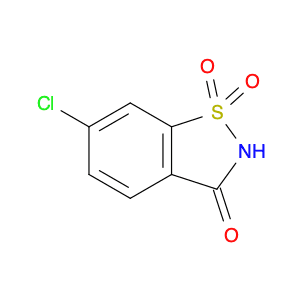
:6-chloro-1,2-benzothiazol-3(2H)-one 1,1-dioxide
Description:
6-Chloro-1,2-benzothiazol-3(2H)-one 1,1-dioxide, with the CAS number 46149-10-4, is a chemical compound that belongs to the class of benzothiazole derivatives. This substance features a benzothiazole ring system, which is characterized by a fused benzene and thiazole ring, and contains a chlorine substituent at the 6-position. The compound is also known for its sulfonyl group, indicated by the "1,1-dioxide" designation, which contributes to its chemical reactivity and potential applications. Typically, compounds of this nature exhibit biological activity, making them of interest in pharmaceutical and agrochemical research. They may possess properties such as antimicrobial, antifungal, or herbicidal activities. The presence of the chlorine atom can influence the compound's lipophilicity and overall stability. In terms of physical properties, it is generally expected to be a solid at room temperature, with solubility varying based on the solvent used. Safety data should be consulted for handling and exposure guidelines, as with all chemical substances.
Formula:C7H4ClNO3S
InChI:InChI=1/C7H4ClNO3S/c8-4-1-2-5-6(3-4)13(11,12)9-7(5)10/h1-3H,(H,9,10)
SMILES:c1cc2c(cc1Cl)S(=O)(=O)N=C2O
Synonyms:- 1,2-Benzisothiazol-3(2H)-one, 6-chloro-, 1,1-dioxide
- 6-Chloro-1,2-benzothiazol-3(2H)-one 1,1-dioxide
Sort by
Purity (%)
0
100
|
0
|
50
|
90
|
95
|
100
Found 4 products.
6-CHLORO-1,2-BENZISOTHIAZOL-3(2H)-ONE 1,1-DIOXIDE
CAS:Formula:C7H4ClNO3SPurity:97%Color and Shape:SolidMolecular weight:217.62966-Chlorobenzo[d]isothiazol-3(2H)-one 1,1-dioxide
CAS:6-Chlorobenzo[d]isothiazol-3(2H)-one 1,1-dioxidePurity:97%Molecular weight:217.63g/mol6-Chloro-1,1-dioxo-1,2-dihydro-1-benzo[d]isothiazol-3-one
CAS:Formula:C7H4ClNO3SPurity:97%Color and Shape:SolidMolecular weight:217.626-Chloro-1,1-dioxo-1,2-dihydro-1-benzo[d]isothiazol-3-one
CAS:6-Chloro-1,1-dioxo-1,2-dihydro-1-benzo[d]isothiazol-3-one is a chemical used for the treatment of bladder cancer. It inhibits the growth of cancer cells by interacting with DNA and inhibiting its synthesis. 6CDAI has been shown to be effective in treating refluxing bladder cancer, but has also been shown to have carcinogenic properties. This drug is metabolized mainly by hydroxylation and then conjugation with glucuronic acid or sulfate.Formula:C7H4ClNO3SPurity:Min. 95%Molecular weight:217.62 g/mol

![6-Chlorobenzo[d]isothiazol-3(2H)-one 1,1-dioxide](/_next/image/?url=https%3A%2Fstatic.cymitquimica.com%2Fproducts%2F54%2Fthumb%2FOR84021.jpg&w=3840&q=75)

![6-Chloro-1,1-dioxo-1,2-dihydro-1-benzo[d]isothiazol-3-one](/_next/image/?url=https%3A%2Fstatic.cymitquimica.com%2Fproducts%2F10%2Fthumb%2FF033130.jpg&w=3840&q=75)

![6-Chloro-1,1-dioxo-1,2-dihydro-1-benzo[d]isothiazol-3-one](/_next/image/?url=https%3A%2Fstatic.cymitquimica.com%2Fproducts%2F3D%2Fthumb%2FWBA14910.jpg&w=3840&q=75)
