CAS 461640-33-5
:Sort by
Purity (%)
0
100
|
0
|
50
|
90
|
95
|
100
Found 4 products.
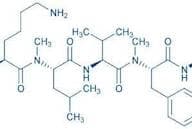
Acetyl-(N-Me-Leu¹⁷,N-Me-Phe¹⁹)-Amyloid β-Protein (16-20) amide
CAS:Membrane-permeable inhibitor of Aβ (1-40) fibrillogenesis.Formula:C39H59N7O6Purity:98.7%Color and Shape:White LyophilisateMolecular weight:721.94Ac-Lys-(Me)Leu-Val-(Me)Phe-Phe-NH2 trifluoroacetate salt
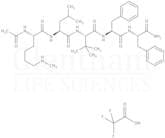
CAS:Formula:C39H59N7O6·xC2HF3O2Molecular weight:721.93 (free base bAc-Lys-N-Me-Leu-Val-N-Me-Phe-Phe-NH2
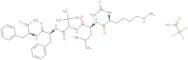
CAS:Ac-Lys-N-Me-Leu-Val-N-Me-Phe-Phe-NH2 is a peptide that has been shown to inhibit the formation of amyloid fibrils in Alzheimer's Disease. Ac-Lys-N-Me-Leu-Val-N-Me-Phe (KLVFF) is a biologically active peptide that is membrane permeable, allowing it to cross the blood brain barrier and enter the central nervous system. It inhibits the fibrillogenesis of amyloid beta protein, preventing it from aggregating into plaques.Formula:C39H59N7O6Purity:Min. 95%Molecular weight:721.95 g/molAc-Lys-(Me)Leu-Val-(Me)Phe-Phe-NH2
CAS:Ac-Lys-(Me)Leu-Val-(Me)Phe-Phe-NH2 is a synthetic chemokine that is a member of the CXC subfamily. Chemokines are small proteins that have a hydrophobic region, which allows them to insert into membranes. This chemokine has been shown to be capable of forming dimers in the presence of other chemokines and exhibits a high degree of homology with congener chemokines. The Ac-Lys-(Me)Leu-Val-(Me)Phe-Phe-NH2 sequence has been shown to denature at pH 8 and has water solubility; however, it does not dissolve in lipid bilayers such as phospholipid bilayers or monolayers. The Ac-Lys-(Me)Leu-Val-(Me)Phe-Phe-NH2 sequence is also stable in an Alzheimer's disease mouse model.
Formula:C39H59N7O6Purity:Min. 95%Molecular weight:721.93 g/mol