CAS 4623-55-6
:2-amino-4-methylthiophene-3-carbonitrile
Description:
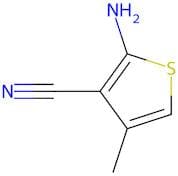
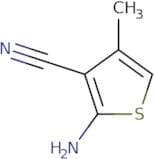
2-Amino-4-methylthiophene-3-carbonitrile is an organic compound characterized by its thiophene ring structure, which is a five-membered aromatic ring containing sulfur. The presence of an amino group (-NH2) at the 2-position and a cyano group (-C≡N) at the 3-position contributes to its reactivity and potential applications in organic synthesis and pharmaceuticals. The methyl group at the 4-position enhances the compound's hydrophobic characteristics and can influence its biological activity. This compound is typically a solid at room temperature and may exhibit moderate solubility in polar organic solvents. Its unique functional groups suggest potential for use in various chemical reactions, including nucleophilic substitutions and coupling reactions. Additionally, the presence of the thiophene moiety may impart interesting electronic properties, making it a candidate for studies in materials science and medicinal chemistry. Safety data should be consulted for handling, as with any chemical substance, to ensure proper precautions are taken during use.
Formula:C6H6N2S
InChI:InChI=1/C6H6N2S/c1-4-3-9-6(8)5(4)2-7/h3H,8H2,1H3
SMILES:Cc1csc(c1C#N)N
Synonyms:- 3-Thiophenecarbonitrile, 2-Amino-4-Methyl-
- 2-Amino-4-methylthiophene-3-carbonitrile
Sort by
Purity (%)
0
100
|
0
|
50
|
90
|
95
|
100
Found 4 products.
2-Amino-4-methylthiophene-3-carbonitrile
CAS:2-Amino-4-methylthiophene-3-carbonitrilePurity:≥95%Color and Shape:SolidMolecular weight:138.19g/mol2-AMINO-4-METHYLTHIOPHENE-3-CARBONITRILE
CAS:Formula:C6H6N2SPurity:95.0%Color and Shape:SolidMolecular weight:138.192-Amino-4-methylthiophene-3-carbonitrile
CAS:2-Amino-4-methylthiophene-3-carbonitrile is a cyclic molecule that has been shown to be reactive with a number of nucleophiles. 2-Amino-4-methylthiophene-3-carbonitrile is an intermediate in the preparation of other organic compounds and has been used to synthesize polymers. It has also been used for kinetic studies and cyclic voltammetry experiments. This compound was found to react with hydrogen peroxide, which led to the formation of an intermolecular hydrogen bond between the two molecules. This type of reaction has not previously been reported for this class of molecules.
Formula:C6H6N2SPurity:Min. 95%Molecular weight:138.19 g/mol