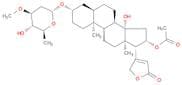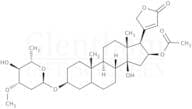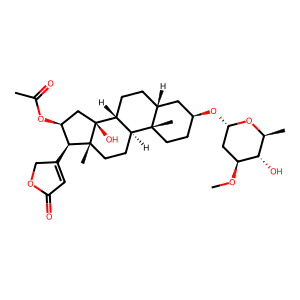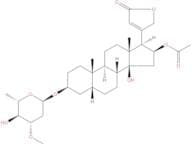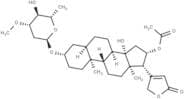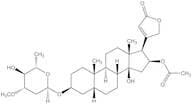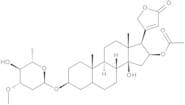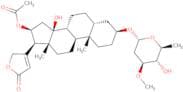
CAS 465-16-7
:Oleandrin
- (3β,5β,16β)-16-(Acetyloxy)-3-[(2,6-dideoxy-3-O-methyl-α-<span class="text-smallcaps">L</span>-arabino-hexopyranosyl)oxy]-14-hydroxycard-20(22)-enolide
- (3β,5β,16β)-16-(acetyloxy)-3-[(2,6-dideoxy-3-O-methyl-α-L-arabino-hexopyranosyl)oxy]-14-hydroxycard-20(22)-enolide
- 16-beta-acetoxy-3-beta-(2,6-dideoxy-3-O-methyl-L-arabino-hexopyranosyloxy)-14-hydroxycard-20(22)-enolide
- Card-20(22)-enolide, 16-(acetyloxy)-3-[(2,6-dideoxy-3-O-methyl-α-<span class="text-smallcaps">L</span>-arabino-hexopyranosyl)oxy]-14-hydroxy-, (3β,5β,16β)-
- Corrigen
- Foliandrin
- Folinerin
- Neriol
- Neriolin
- Neriostene
- Oleandrigenin 3-O-α-<span class="text-smallcaps">L</span>-oleandroside
- Oleandrine
- Oleandrin
- See more synonyms
Oleandrin
CAS:Oleandrin, a cardiac glycoside, regulates BDNF, inhibits Na/K-ATPase, boosts calcium in heart muscle, and hinders CaCO-2 cell growth.Formula:C32H48O9Purity:98% - 99.94%Color and Shape:Crystals From Dilute Methanol SolidMolecular weight:576.72Ref: TM-T5S0890
1mg81.00€5mg170.00€10mg281.00€25mg592.00€50mg945.00€100mg1,288.00€200mg1,738.00€1mL*10mM (DMSO)224.00€Oleandrin
CAS:Natural glycosideFormula:C32H48O9Purity:≥ 95.0 % (HPLC)Color and Shape:PowderMolecular weight:576.73Oleandrin
CAS:Applications Cardiotonic; diuretic.
Not a dangerous good if item is equal to or less than 1g/ml and there is less than 100g/ml in the package
References Sreenivasan, Y., et al.: Biochem. Pharmacol., 66, 2223 (2003), Ni, D., et al.: J. Exp. Ther. Oncol., 2, 278 (2002), Langford, S.D., Toxicology, 109,1 (1996),Formula:C32H48O9Color and Shape:White To Off-WhiteMolecular weight:576.72Oleandrin
CAS:Oleandrin is a naturally occurring toxic cardiac glycoside, which is a chemical compound extracted from the leaves and stems of the Nerium oleander plant. Its mode of action involves inhibiting the Na+/K+-ATPase pump, leading to an increase in intracellular sodium concentration and a secondary increase in intracellular calcium levels. This cascade of ion movements enhances cardiac contractility and can disrupt regular cardiac rhythm, which is a hallmark of cardiac glycosides.
Formula:C32H48O9Purity:Min. 98 Area-%Color and Shape:PowderMolecular weight:576.72 g/molRef: 3D-MO26544
Discontinued product