CAS 466-61-5
:(-)-Lycopodine
Description:
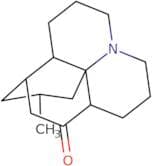
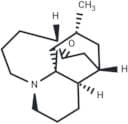
(-)-Lycopodine is a naturally occurring alkaloid primarily derived from various species of the Lycopodium genus, which are clubmosses. This compound is characterized by its complex bicyclic structure, featuring a tetracyclic framework that includes a nitrogen atom, contributing to its classification as a bicyclic alkaloid. (-)-Lycopodine exhibits a range of biological activities, including potential anti-inflammatory and analgesic properties, making it of interest in pharmacological research. The compound is typically found in a crystalline form and is known for its distinctive stereochemistry, which is crucial for its biological activity. Its solubility varies depending on the solvent, and it is often studied for its interactions with biological systems. Due to its structural complexity, (-)-Lycopodine is also a subject of synthetic organic chemistry, where researchers explore methods to synthesize this compound and its derivatives for potential therapeutic applications. Overall, (-)-Lycopodine represents an intriguing area of study within natural product chemistry and pharmacognosy.
Formula:C16H25NO
InChI:InChI=1S/C16H25NO/c1-11-8-12-9-15(18)14-5-3-7-17-6-2-4-13(12)16(14,17)10-11/h11-14H,2-10H2,1H3/t11-,12+,13-,14-,16-/m1/s1
InChI key:InChIKey=BCZFSDNVXODRAJ-JTTNIQEDSA-N
SMILES:O=C1[C@@]2([C@]34[C@@]([C@](C1)(C[C@@H](C)C3)[H])(CCC[N@]4CCC2)[H])[H]
Synonyms:- (15R)-15-Methyllycopodan-5-one
- (1S,8aR,9S,11R,12aR)-Dodecahydro-11-methyl-1,9-ethanobenzo[i]quinolizin-14-one
- 1,9-Ethanobenzo[i]quinolizin-14-one, dodecahydro-11-methyl-, (1S,8aR,9S,11R,12aR)-
- 1,9-Ethanobenzo[i]quinolizin-14-one, dodecahydro-11-methyl-, [1S-(1α,8aα,9β,11α,12aS*)]-
- Lycopodan-5-one, 15-methyl-, (15R)-
- Lycopodan-5-one, 15-methyl-, (15R)- (9CI)
- Lycopodine
Sort by
Purity (%)
0
100
|
0
|
50
|
90
|
95
|
100
Found 2 products.
Lycopodine
CAS:Lycopodine is a type of alkaloid, which is a biologically active compound found in various plant species. It is derived primarily from the club mosses of the Lycopodiaceae family, such as Lycopodium clavatum and related species. The mode of action of lycopodine involves interaction with neurological pathways, although the exact mechanisms are still under investigation.
Formula:C16H25NOPurity:Min. 95%Molecular weight:247.38 g/molLycopodine
CAS:Lycopodine, a bioactive compound derived from Lycopodium clavatum spores, effectively inhibits the proliferation of HeLa cells through the induction of
Formula:C16H25NOPurity:98%Color and Shape:SolidMolecular weight:247.38