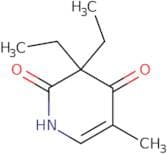
CAS 467-90-3
:3,3-Diethyl-5-methyl-2,4(1H,3H)-pyridinedione
Description:
3,3-Diethyl-5-methyl-2,4(1H,3H)-pyridinedione, also known by its CAS number 467-90-3, is an organic compound belonging to the class of pyridinediones. This substance features a pyridine ring substituted with two ethyl groups at the 3-position and a methyl group at the 5-position, along with two carbonyl groups at the 2 and 4 positions, contributing to its diketone nature. The compound is typically characterized by its yellow to orange color and exhibits a strong absorption in the UV-visible spectrum due to the presence of conjugated double bonds. It is soluble in organic solvents such as ethanol and acetone but has limited solubility in water. 3,3-Diethyl-5-methyl-2,4(1H,3H)-pyridinedione is often used in organic synthesis and may serve as a ligand in coordination chemistry due to its ability to chelate metal ions. Its reactivity and stability can vary depending on the conditions, making it a compound of interest in various chemical applications.
Formula:C10H15NO2
InChI:InChI=1S/C10H15NO2/c1-4-10(5-2)8(12)7(3)6-11-9(10)13/h6H,4-5H2,1-3H3,(H,11,13)
InChI key:InChIKey=WELBEQNHUMMKEL-UHFFFAOYSA-N
SMILES:C(C)C1(CC)C(=O)C(C)=CNC1=O
Synonyms:- Methylpyrithyldione
- 2,4(1H,3H)-Pyridinedione, 3,3-diethyl-5-methyl-
- 5-Methylpyrithyldione
- 3,3-Diethyl-5-methyl-2,4(1H,3H)-pyridinedione
- Ethypicone
Sort by
Purity (%)
0
100
|
0
|
50
|
90
|
95
|
100
Found 1 products.
3,3-Diethyl-5-methyl-1,2,3,4-tetrahydropyridine-2,4-dione
CAS:3,3-Diethyl-5-methyl-1,2,3,4-tetrahydropyridine-2,4-dione is an insoluble hydrophobic implantable drug that can be reconstituted with a diluent and injected. It has been developed as a targetable drug delivery system for iontophoresis devices and has shown clinical effects in the treatment of various diseases. 3,3-Diethyl-5-methyl-1,2,3,4-tetrahydropyridine-2,4-dione is a bioactive agent that acts as an ion channel blocker. It inhibits the uptake of calcium ions into cells by blocking voltage gated calcium channels in the cell membrane. This leads to a reduction in intracellular free calcium concentration and subsequent inhibition of cellular activity.Formula:C10H15NO2Purity:Min. 95%Molecular weight:181.23 g/mol