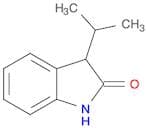
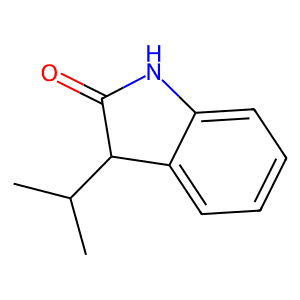
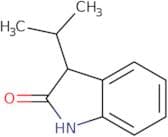
CAS 4679-87-2
:2H-Indol-2-one, 1,3-dihydro-3-(1-methylethyl)-
Description:
2H-Indol-2-one, 1,3-dihydro-3-(1-methylethyl)-, also known by its CAS number 4679-87-2, is a chemical compound that belongs to the indole family, characterized by a bicyclic structure containing a fused benzene and pyrrole ring. This compound features a diketopiperazine structure, which contributes to its unique properties. It is typically a colorless to pale yellow solid or liquid, depending on its form and purity. The presence of the isopropyl group (1-methylethyl) at the 3-position of the indole ring influences its solubility and reactivity, making it more hydrophobic. This compound may exhibit biological activity, including potential pharmacological effects, which makes it of interest in medicinal chemistry. Its derivatives are often studied for their roles in various biological processes and their potential therapeutic applications. As with many organic compounds, handling should be done with care, considering safety data and potential hazards associated with its use.
Formula:C11H13NO
Sort by
Purity (%)
0
100
|
0
|
50
|
90
|
95
|
100
Found 4 products.
3-Propan-2-yl-1,3-dihydroindol-2-one
CAS:3-Propan-2-yl-1,3-dihydroindol-2-onePurity:98%Molecular weight:175.23g/mol3-(Propan-2-yl)-2,3-dihydro-1H-indol-2-one
CAS:3-(Propan-2-yl)-2,3-dihydro-1H-indol-2-one is an oxindole derivative that binds to the adrenergic receptor. It has been shown to be a selective agonist of the atrial adrenergic receptor (A1), and has been used in the synthesis of pyrrole derivatives. 3-(Propan-2-yl)-2,3-dihydro-1H-indol-2-one also binds to serotonin receptors and may have antidepressant properties. 3-(Propan-2-yl)-2,3-dihydro-1H -indol - 2 one is a member of a family of compounds known as oxindoles. Oxindole derivatives are synthesized by deprotonating an alkyl bromide with butyllithium followed by reaction with pyrrole or an aromatic amine such as aniline or benzaldehyde. The resultingFormula:C11H13NOPurity:Min. 95%Molecular weight:175.23 g/mol