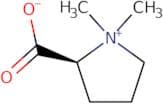
CAS 471-87-4
:(-)-Stachydrine
Description:
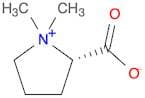
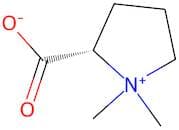
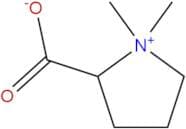
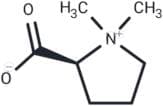
(-)-Stachydrine, with the CAS number 471-87-4, is a naturally occurring alkaloid primarily found in various plant species, particularly in the family of Lamiaceae. It is characterized by its chemical structure, which includes a pyridine ring and a quaternary ammonium group, contributing to its biological activity. This compound is known for its potential pharmacological properties, including anti-inflammatory and neuroprotective effects. (-)-Stachydrine is often studied for its role in traditional medicine and its potential therapeutic applications. In terms of physical properties, it is typically a white crystalline solid, soluble in water and alcohol, which facilitates its extraction from plant sources. The stereochemistry of (-)-Stachydrine is significant, as the specific configuration can influence its biological interactions and efficacy. Overall, this compound represents an interesting subject of study in both natural product chemistry and pharmacology, highlighting the importance of plant-derived substances in medicinal research.
Formula:C7H14NO2
InChI:InChI=1/C7H13NO2/c1-8(2)5-3-4-6(8)7(9)10/h6H,3-5H2,1-2H3/t6-/m0/s1
InChI key:InChIKey=CMUNUTVVOOHQPW-LURJTMIESA-N
SMILES:C([O-])(=O)[C@H]1[N+](C)(C)CCC1
Synonyms:- (2S)-1,1-Dimethylpyrrolidin-1-ium-2-carboxylate
- (S)-1,1-Dimethylpyrrolidin-1-ium-2-carboxylate
- (S)-2-Carboxy-1,1-dimethylpyrrolidinium hydroxide inner salt
- 1,1-Dimethylpyrrolidinium-2-Carboxylate
- 1-Methylproline methylbetaine
- <span class="text-smallcaps">L</span>-Stachydrine
- Cadabine
- Hygric acid, methylbetaine
- Methyl hygrate betaine
- N,N-Dimethyl-<span class="text-smallcaps">L</span>-proline
- Proline betaine
- Pyrrolidinium, 2-carboxy-1,1-dimethyl-, hydroxide, inner salt, (S)-
- Pyrrolidinium, 2-carboxy-1,1-dimethyl-, inner salt, (2S)-
- S-(-)-Stachydrine
- Stachydrin
- α-N-Dimethyl-<span class="text-smallcaps">L</span>-proline
- Stachydrine
- L-stachydrine
- N,N-Dimethyl-L-proline USP/EP/BP
- (Pyrrolidinium, 2-carboxy-1,1-dimethyl-, innersalt, (2S)-
- N-Dimethyl-L-proline
- (2S)-2-Carboxylato-1,1-dimethylpyrrolidin-1-ium
- (2s)-1,1-dimethylpyrrolidinium-2-carboxylate
- N,N-Dimethyl-L-Proline ( (-)-Stachydrine)
- (s)-2-carboxylato-1,1-dimethylpyrrolidinium
- Stachydrine, >98%
- (2S)-1,1-Dimethyl-2-carboxylatopyrrolidin-1-ium
- n,n-dimethyl-l-proline
- See more synonyms
Sort by
Purity (%)
0
100
|
0
|
50
|
90
|
95
|
100
Found 7 products.
(S)-1,1-Dimethylpyrrolidin-1-ium-2-carboxylate
CAS:Formula:C7H13NO2Purity:98%Color and Shape:SolidMolecular weight:143.1836N,N-Dimethyl-L-Proline Iodide ((-)-Stachydrine Iodide)
CAS:Formula:C7H14NO2·IMolecular weight:144.19 126.91Stachydrine
CAS:Stachydrine, found in leonurus herb, aids blood flow, blocks NF-κB pathway, and indicates citrus intake.Formula:C7H13NO2Purity:99.94% - ≥95%Color and Shape:SolidMolecular weight:143.18Stachydrine
CAS:Stachydrine is a naturally occurring alkaloid, primarily found in plants such as Leonurus japonicus and various species of the genus Stachys. This compound, classified as a pyrrolidine betaine, is derived from botanical sources with traditional medicinal use in several cultures. The mode of action of stachydrine includes modulating cardiovascular functions, potentially through vasodilatory effects and influencing platelet aggregation. These biochemical interactions suggest a role in improving blood circulation and exerting cardioprotective effects. As such, stachydrine is the focus of ongoing research regarding its application in managing cardiovascular disorders, particularly those involving impaired blood flow or clotting irregularities. Furthermore, its potential anti-inflammatory and anti-fibrotic properties are being explored, indicating broader therapeutic implications beyond the cardiovascular system.Formula:C7H13NO2Purity:Min. 95%Color and Shape:PowderMolecular weight:143.18 g/mol(S)-1,1-Dimethylpyrrolidin-1-ium-2-carboxylate
CAS:Formula:C7H13NO2Purity:98%Color and Shape:SolidMolecular weight:143.186