CAS 4714-67-4
:4-Aminobenzenecarbothioamide
Description:
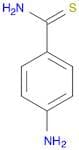
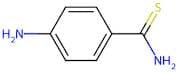
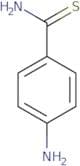
4-Aminobenzenecarbothioamide, also known as p-aminobenzenethioamide, is an organic compound characterized by the presence of an amino group (-NH2) and a thioamide functional group (-C(S)NH2) attached to a benzene ring. This compound typically appears as a solid and is soluble in polar solvents due to its ability to form hydrogen bonds. It exhibits properties typical of thioamides, including potential reactivity in nucleophilic substitution reactions and the ability to participate in various organic synthesis pathways. The amino group contributes to its basicity and can engage in further chemical reactions, such as acylation or alkylation. 4-Aminobenzenecarbothioamide may also display biological activity, making it of interest in medicinal chemistry and drug development. Safety data indicates that, like many amines and thioamides, it should be handled with care due to potential toxicity and irritant properties. Overall, its unique functional groups make it a versatile compound in both synthetic and biological contexts.
Formula:C7H8N2S
InChI:InChI=1/C7H8N2S/c8-6-3-1-5(2-4-6)7(9)10/h1-4H,8H2,(H2,9,10)
InChI key:InChIKey=LZJVSPPXXGXGQL-UHFFFAOYSA-N
SMILES:C(N)(=S)C1=CC=C(N)C=C1
Synonyms:- 4-Aminobenzene-1-carbothioamide
- 4-Aminobenzenecarbothioamide
- Benzamide, p-aminothio-
- Benzenecarbothioamide, 4-amino-
- NSC 18337
- p-Aminobenzothiamide
- 4-Aminothiobenzamide
- p-AminoThioBenzamide
- p-aminothio-benzamid
- 4-amino-benzenecarbothioamid
- PARA-AMINOTHIOBENZAMIDE
- See more synonyms
Sort by
Purity (%)
0
100
|
0
|
50
|
90
|
95
|
100
Found 4 products.
4-Aminothiobenzamide
CAS:4-AminothiobenzamidePurity:97%Color and Shape:PowderMolecular weight:152.21681g/mol4-Aminothiobenzamide
CAS:4-Aminothiobenzamide (4ATB) is a chemical compound that is used as an anticancer agent and an antimicrobial agent. It has been shown to have antitumor activity against human liver cancer cells and anticancer activity against human adrenergic receptor-positive lung cancer cells. 4ATB binds to the chloride ion present in the cell membrane, which prevents the influx of chloride ions into the cell. This leads to an increase in intracellular pH and disruption of cellular functions. 4ATB has also been shown to inhibit methicillin-resistant Staphylococcus aureus (MRSA) infections by inhibiting bacterial growth and reducing the production of proteins vital for cell division.Formula:C7H8N2SPurity:Min. 95%Color and Shape:PowderMolecular weight:152.22 g/mol