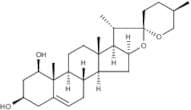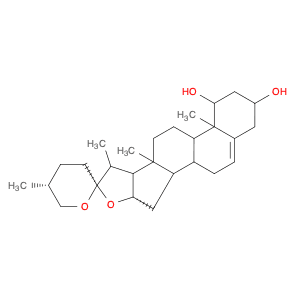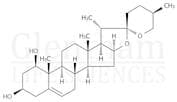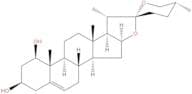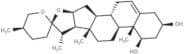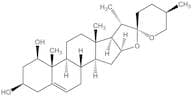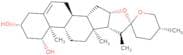
CAS 472-11-7
:Ruscogenin
- (1beta,3beta,22xi,25R)-spirost-5-en-1,3-diol
- (1beta,3beta,25R)-spirost-5-en-1,3-diol
- (1β,3β,25R)-Spirost-5-ene-1,3-diol
- 25<span class="text-smallcaps">D</span>-Spirost-5-ene-1β,3β-diol
- 25R-Ruscogenin
- Ruscogenin
- Ruscogenine
- Spiro[8H-naphth[2′,1′:4,5]indeno[2,1-b]furan-8,2′-[2H]pyran], spirost-5-ene-1,3-diol deriv.
- Spirost-5-ene-1,3-diol, (1β,3β,25R)-
- Spirost-5-ene-1β,3β-diol, (25R)-
Ruscogenin
CAS:Ruscogenin analytical standard provided with chromatographic purity, to be used as reference material for qualitative determination.Formula:C27H42O4Purity:(HPLC) ≥95%Color and Shape:PowderMolecular weight:430.63Ruscogenin
CAS:Formula:C27H42O4Purity:≥ 98.0%Color and Shape:White to off-white powderMolecular weight:430.63Ruscogenin
CAS:Ruscogenin exerts significant anti-inflammatory and anti-thrombotic activities.Ruscogenin significantly attenuates LPS-induced acute lung injury (ALI )via inhibiting expressions of TF and iNOS and NF-κB p65 activation, it inhibits activation of neutrophil through cPLA 2 , PAK, Akt, MAPKs, cAMP, and PKA signaling pathways.Formula:C27H42O4Purity:95%~99%Molecular weight:430.629Ruscogenin
CAS:Oxygen-heterocyclic compoundFormula:C27H42O4Purity:≥ 95.0 % (HPLC)Color and Shape:PowderMolecular weight:430.63Ruscogenin
CAS:Applications A major steroidal sapogenin from Radix ophiopogon japonicus with robust anti-inflammatory and anti-thrombotic activities. Studies suggest that it inhibits adhesion of leukocytes to a human umbilical vein endothelial cell line (ECV304) injured by tumor necrosis factor-α (TNF-α) in a concentration-dependent manner.
References Huang, Y. et al.: Drug Dev. Res., 69, 196 (2008); Huang, Y. et al.: J. Pharmacol. Sci., 108, 198 (2008); Song, J. et al.: J. Pharmacol. Sci., 113, 409 (2010);Formula:C27H42O4Color and Shape:NeatMolecular weight:430.62Ruscogenin
CAS:Ruscogenin is a steroidal saponin, which is derived from the underground parts of plants belonging to the genus *Ruscus*, commonly known as butcher's broom. This compound is extracted primarily from the rhizomes of these plants. Its mode of action involves modulating inflammatory pathways by inhibiting the release of pro-inflammatory cytokines, thereby reducing inflammation. Additionally, ruscogenin has been observed to enhance vascular integrity and reduce capillary permeability.
Formula:C27H42O4Purity:Min. 95%Molecular weight:430.62 g/mol