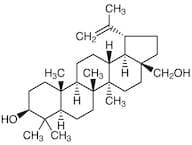
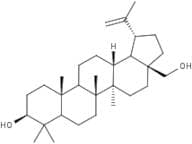
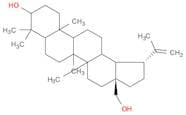
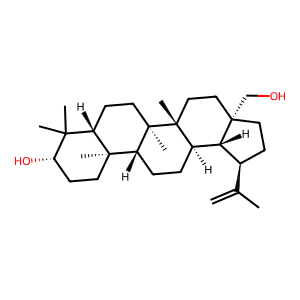
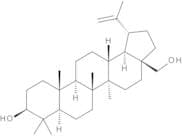
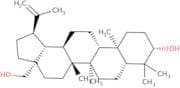
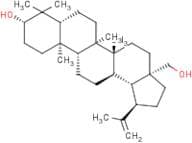
CAS 473-98-3
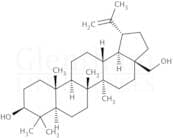
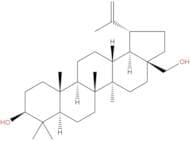
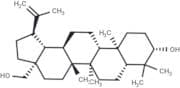
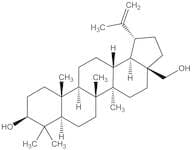
:Betulin
- (3Beta)-Lup-20(29)-Ene-3,28-Diol
- (3Beta,5Xi,9Xi,13Xi,14Xi,18Xi,19Xi)-Lup-20(29)-Ene-3,28-Diol
- (3Beta,5Xi,9Xi,18Xi)-Lup-20(29)-Ene-3,28-Diol
- (3β)-Lup-20(29)-ene-3,28-diol
- 3,28-Dihydroxy-lupeol
- 3aH-Cyclopenta[a]chrysene, lup-20(29)-ene-3,28-diol deriv.
- 3β,28-Dihydroxylup-20(29)-ene
- Betuline
- Betulinic alcohol
- Betulinol
- Betulol
- Lup-20(29)-Ene-3,28-Diol
- Lup-20(29)-en-3,28-diol, (3β)-
- Lup-20(29)-ene-3,28-diol, (3β)-
- Lup-20(29)-ene-3β,28-diol
- Lup-20(30)-ene-3β,28-diol
- Lupene-20(29) Diol-3,28, (3Β)-
- Nsc 4644
- See more synonyms
Betulinol
CAS:Formula:C30H50O2Purity:>97.0%(GC)Color and Shape:White to Light yellow powder to crystalineMolecular weight:442.73Betulin
CAS:Betulin analytical standard provided with w/w absolute assay, to be used for quantitative titration.Formula:C30H50O2Purity:(HPLC) ≥98%Color and Shape:PowderMolecular weight:442.73Lup-20(29)-ene-3b,28-diol
CAS:Formula:C30H50O2Purity:98%Color and Shape:SolidMolecular weight:442.7168Betulin
CAS:Formula:C30H50O2Purity:≥ 98.0%Color and Shape:White to off-white powderMolecular weight:442.72Betulin
CAS:Betulin (betulinol) (lup-20(29)-ene-3β, 28-diol) is an abundant, naturally occurring triterpene.
Formula:C30H50O2Purity:98.52% - 99.88%Color and Shape:White Crystalline PowderMolecular weight:442.72Betulin
CAS:Cyclic alcoholFormula:C30H50O2Purity:≥ 95.0 % (HPLC)Color and Shape:PowderMolecular weight:442.73Betulin
CAS:Controlled ProductStability Hygroscopic
Applications Betulin is a derivative of Betulinic Acid (B330250), used in the treatment of cancer and HIV disease. Betulinic Acid selectively induces apoptosis in tumor cells by directly activating the mitochondrial pathway of apoptosis through a p53- and CD95-independent mechanism. Betulinic Acid also exhibits TGR5 agonist activity
References Cichewicz, R. et al.: Med. Res. Rev., 24, 90 (2003); Pisha, E. et al.: Nat. Med., 1, 1046 (1995); Fulda, S. et al.: Cancer Res., 57, 4956 (1997); Kashiwada, Y. et al.: J. Med. Chem., 39, 1016 (1996); Genet, C. et al.: J. Med. Chem., 53, 178 (2010);Formula:C30H50O2Color and Shape:White PowderMolecular weight:442.72Betulin
CAS:Controlled ProductBetulin is a natural compound found in the bark of the birch tree. It has potent angiogenic properties and induces the growth of new blood vessels. Betulin also has anti-inflammatory activity and has been shown to inhibit the production of pro-inflammatory cytokines, such as TNF-α, IL-1β, and IL-6. Betulin is a potent inducer of apoptosis in human cancer cells. It also inhibits the mitochondrial membrane potential, which results in cell death. This drug also appears to have an effect on oral pathogens by reducing their virulence and ability to adhere to epithelial cells. In addition, betulin can be used as an analytical reference standard for preparative high performance liquid chromatography (HPLC). Experimental studies have shown that betulin interacts with drugs that are metabolized by cytochrome P450 enzymes.Formula:C30H50O2Purity:Min. 98 Area-%Color and Shape:White PowderMolecular weight:442.72 g/molBetulin-d3
CAS:Controlled ProductApplications Betulin-d3 is the isotope labelled analog of Betulin (B330240); a derivative of Betulinic Acid (B330250) which is a compound used in the treatment of cancer and HIV disease. Betulinic Acid selectively induces apoptosis in tumor cells by directly activating the mitochondrial pathway of apoptosis through a p53- and CD95-independent mechanism. Betulinic Acid also exhibits TGR5 agonist activity
References Cichewicz, R. et al.: Med. Res. Rev., 24, 90 (2003); Pisha, E. et al.: Nat. Med., 1, 1046 (1995); Fulda, S. et al.: Cancer Res., 57, 4956 (1997); Kashiwada, Y. et al.: J. Med. Chem., 39, 1016 (1996); Genet, C. et al.: J. Med. Chem., 53, 178 (2010)Formula:C30H47D3O2Color and Shape:NeatMolecular weight:445.74