CAS 473706-11-5
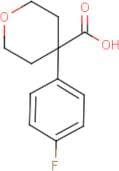
:4-(4-fluorophenyl)tetrahydro-2H-pyran-4-carboxylic acid
Description:
4-(4-Fluorophenyl)tetrahydro-2H-pyran-4-carboxylic acid is an organic compound characterized by its tetrahydropyran ring structure, which is a six-membered cyclic ether containing one oxygen atom. The presence of a carboxylic acid functional group (-COOH) indicates that it can act as an acid, participating in various chemical reactions, including esterification and amidation. The fluorophenyl substituent enhances its lipophilicity and may influence its biological activity, making it of interest in medicinal chemistry. This compound is typically a white to off-white solid and is soluble in polar organic solvents. Its molecular structure suggests potential applications in pharmaceuticals, particularly in the development of compounds targeting specific biological pathways. The CAS number 473706-11-5 uniquely identifies this substance, facilitating its recognition in chemical databases and literature. Overall, the characteristics of this compound make it a subject of interest for further research in organic synthesis and drug development.
Formula:C12H13FO3
InChI:InChI=1/C12H13FO3/c13-10-3-1-9(2-4-10)12(11(14)15)5-7-16-8-6-12/h1-4H,5-8H2,(H,14,15)
SMILES:c1cc(ccc1C1(CCOCC1)C(=O)O)F
Synonyms:- 2H-Pyran-4-carboxylic acid, 4-(4-fluorophenyl)tetrahydro-
- 4-(4-Fluorophenyl)tetrahydro-2H-pyran-4-carboxylic acid
Sort by
Purity (%)
0
100
|
0
|
50
|
90
|
95
|
100
Found 4 products.
4-(4-Fluoro-phenyl)-tetrahydro-pyran-4-carboxylic acid
CAS:Formula:C12H13FO3Purity:95%Color and Shape:SolidMolecular weight:224.22824-(4-Fluorophenyl)oxane-4-carboxylic acid
CAS:4-(4-Fluorophenyl)oxane-4-carboxylic acidPurity:97%Molecular weight:224.23g/mol4-(4-Fluoro-phenyl)-tetrahydro-pyran-4-carboxylic acid
CAS:4-(4-Fluoro-phenyl)-tetrahydro-pyran-4-carboxylic acid is a research chemical with various potential applications. It has been studied for its role in interferon signaling and its interaction with daclatasvir, an antiviral drug used to treat hepatitis C. Additionally, this compound has shown monoamine modulating properties, which may have implications in the treatment of neurological disorders. Magnetic resonance spectroscopy studies have revealed its polymorphic nature, suggesting potential variations in its physical and chemical properties. Furthermore, it has been investigated for its effects on fatty acid metabolism and its potential as an acetylcholine receptor agonist. This versatile compound holds promise as a valuable tool for further research in the field of neuroscience and beyond.Formula:C12H13FO3Purity:Min. 95%Molecular weight:224.23 g/mol