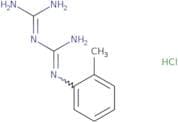
CAS 4751-99-9
:1-(diaminomethylidene)-2-(2-methylphenyl)guanidine hydrochloride
Description:
1-(Diaminomethylidene)-2-(2-methylphenyl)guanidine hydrochloride, with the CAS number 4751-99-9, is a chemical compound that belongs to the class of guanidine derivatives. It is characterized by the presence of a guanidine functional group, which is known for its basicity and ability to form hydrogen bonds. This compound typically appears as a white to off-white crystalline solid and is soluble in water, which is a common trait for many guanidine derivatives. Its structure includes two amino groups and a phenyl ring substituted with a methyl group, contributing to its unique chemical properties. The hydrochloride form indicates that it is a salt, which can enhance its stability and solubility in aqueous solutions. This compound may exhibit biological activity, making it of interest in pharmaceutical research, particularly in the development of therapeutic agents. However, specific applications and safety profiles would require further investigation and should be approached with caution in laboratory settings.
Formula:C9H14ClN5
InChI:InChI=1/C9H13N5.ClH/c1-6-4-2-3-5-7(6)13-9(12)14-8(10)11;/h2-5H,1H3,(H6,10,11,12,13,14);1H
SMILES:Cc1ccccc1NC(=N)NC(=N)N.Cl
Synonyms:- 1-{[{[Amino(Imino)Methyl]Amino}(Imino)Methyl]Amino}-2-Methylbenzene Hydrochloride
- imidodicarbonimidic diamide, N-(2-methylphenyl)-, hydrochloride (1:1)
- N-(2-methylphenyl)imidodicarbonimidic diamide hydrochloride
- N-(2-Methylphenyl)imidodicarbonimidic diamide hydrochloride (1:1)
Sort by
Purity (%)
0
100
|
0
|
50
|
90
|
95
|
100
Found 2 products.
o-Tolylbiguanide hydrochloride
CAS:o-Tolylbiguanide hydrochloride is a copper-containing antimicrobial agent that has been synthesised and used to treat Gram-negative bacteria. It is an anion, which means it can be reduced by agents such as formaldehyde and chloride. o-Tolylbiguanide hydrochloride binds to the anionic groups of the bacterial cell wall, which are found in proteins and lipids. This binding prevents the formation of a covalent bond between the copper ion and the bacterial cell wall, preventing further growth. The elimination of this compound in vivo is thought to be due to its organic ligands.
Formula:C9H14ClN5Purity:Min. 95%Molecular weight:227.69 g/mol