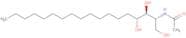
CAS 475995-69-8
:N-acetoyl 4-hydroxysphinganine (SaccharoMyces Cerevisiae)
Description:
N-acetoyl 4-hydroxysphinganine, also known as a derivative of sphinganine, is a bioactive lipid molecule primarily associated with various biological functions in organisms, including yeast such as Saccharomyces cerevisiae. This compound features a sphingoid backbone with an acetyl group at the nitrogen position and a hydroxyl group at the 4-position, contributing to its amphipathic nature. It plays a crucial role in cellular signaling and membrane structure, influencing processes such as apoptosis and cell differentiation. The presence of the hydroxyl group enhances its solubility in polar solvents, while the acetyl group can modulate its biological activity and interactions with other biomolecules. N-acetoyl 4-hydroxysphinganine is also involved in the synthesis of complex sphingolipids, which are essential for maintaining cellular integrity and function. Its CAS number, 475995-69-8, identifies it uniquely in chemical databases, facilitating research and application in biochemistry and pharmacology. Overall, this compound exemplifies the intricate relationship between lipid metabolism and cellular physiology.
Formula:C20H41NO4
Synonyms:- N-ACETOYL 4-HYDROXYSPHINGANINE (SACCHAROMYCES CEREVISIAE);N-02:0 PHYTOSPHINGOSINE
- N-acetoyl 4-hydroxysphinganine (SaccharoMyces Cerevisiae)
- N-02:0 Phytosphingosine
- Sphingosines, phytosphingosines, N-acetyl, Saccharomyces cerevisiae
Sort by
Purity (%)
0
100
|
0
|
50
|
90
|
95
|
100
Found 1 products.
N-Acetyl-phytosphingosine
CAS:N-Acetyl-phytosphingosine is a sphingoid base that functions as a phospholipid constituent of the cell membrane. It participates in the regulation of calcium and lipid metabolism, as well as cell proliferation and differentiation. N-Acetyl-phytosphingosine has been shown to suppress the production of prostaglandin E2, which may be due to its ability to inhibit cyclooxygenases and their downstream products, prostaglandin synthesis. This compound also represses activity of human cancer cells by intercepting the process that leads to prostaglandin synthesis. The anti-inflammatory effect of this molecule is demonstrated by its ability to reduce inflammation in keratinocytes (skin cells) and human keratinocytes.
Formula:C20H41NO4Purity:Min. 98 Area-%Color and Shape:PowderMolecular weight:359.54 g/molRef: 3D-FA16354
Discontinued product