CAS 479-13-0
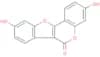
:Coumestrol
Description:
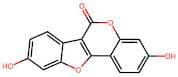
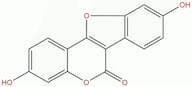
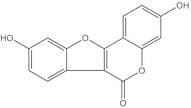
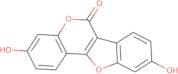
Coumestrol is a naturally occurring phytoestrogen, classified as a coumestan, which is a type of flavonoid. It is primarily found in various legumes, particularly in alfalfa and clover. Coumestrol exhibits estrogenic activity, meaning it can bind to estrogen receptors and mimic the effects of estrogen in the body, which has implications for both plant biology and potential health effects in humans. The chemical structure of coumestrol features a fused benzopyran ring system, contributing to its biological activity. It is often studied for its potential role in modulating hormonal activity and its effects on reproductive health. Additionally, coumestrol has been investigated for its antioxidant properties and potential protective effects against certain diseases. Its solubility characteristics typically indicate that it is more soluble in organic solvents than in water, which influences its bioavailability and interaction within biological systems. Overall, coumestrol represents an interesting compound in both nutritional science and pharmacology due to its diverse biological activities.
Formula:C15H8O5
InChI:InChI=1S/C15H8O5/c16-7-1-3-9-11(5-7)19-14-10-4-2-8(17)6-12(10)20-15(18)13(9)14/h1-6,16-17H
InChI key:InChIKey=ZZIALNLLNHEQPJ-UHFFFAOYSA-N
SMILES:O=C1C2=C(C=3C(O1)=CC(O)=CC3)OC=4C2=CC=C(O)C4
Synonyms:- 2-(2,4-Dihydroxyphenyl)-6-hydroxy-3-benzofurancarboxylic acid δ-lactone
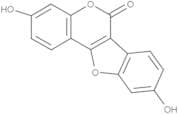
- 3,9-Dihydroxy-6H-benzofuro(3,2-c)(1)benzopyran-6-one
- 3,9-Dihydroxy-[1]benzofuro[3,2-c]chromen-6-one
- 3,9-dihydroxy-6H-[1]benzofuro[3,2-c]chromen-6-one
- 3-Benzofurancarboxylic acid, 2-(2,4-dihydroxyphenyl)-6-hydroxy-, delta-lactone (6CI)
- 3-Benzofurancarboxylic acid, 2-(2,4-dihydroxyphenyl)-6-hydroxy-, δ-lactone
- 6H-Benzofuro(3,2-c)(1)benzopyran-6-one, 3,9-dihydroxy-
- Brn 0266702
- Ccris 7311
- Coumesterol
- Cumoesterol
- Cumoestrol
- Cumostrol
- Nsc 22842
- See more synonyms
Sort by
Purity (%)
0
100
|
0
|
50
|
90
|
95
|
100
Found 10 products.
Coumestrol
CAS:Coumestrol analytical standard provided with w/w absolute assay, to be used for quantitative titration.Formula:C15H8O5Purity:(HPLC) ≥98%Color and Shape:PowderMolecular weight:268.233,9-Dihydroxy-6H-[1]benzofuro[3,2-c]chromen-6-one
CAS:Formula:C15H8O5Purity:98%Color and Shape:SolidMolecular weight:268.2210Coumestrol
CAS:Coumestrol in soybeans inhibits ES2 cell growth (IC50: 50 μM) and combats neurological issues, cancer, and autoimmunity.Formula:C15H8O5Purity:96.23% - 99.23%Color and Shape:SolidMolecular weight:268.22Coumestrol
CAS:LactoneFormula:C15H8O5Purity:≥ 90.0 % (HPLC)Color and Shape:PowderMolecular weight:268.22Coumestrol
CAS:Controlled ProductApplications This compound has estrogenic activity. It exhibits bright blue fluorescence in neutral or acid solution, and greenish-yellow fluorescence in strong alkali solution.
References Wolfbeis, O.S. & K. Schaffner: Photochem. Photobiol., 32, 143(1980), Bickoff et al.: J.Am. Chem Soc. 80, 3969 (1958)Formula:C15H8O5Color and Shape:NeatMolecular weight:268.22Coumestrol
CAS:Coumestrol is a phytoestrogen compound, which is a naturally occurring compound found in a variety of plants, such as soybeans, clover, and alfalfa. It is derived from the metabolic processes within these plants. Coumestrol exhibits estrogenic activity, acting as an agonist for estrogen receptors. This biological activity enables coumestrol to mimic the action of endogenous estrogens, thereby influencing estrogen-responsive pathways.Formula:C15H8O5Purity:Min. 95%Color and Shape:PowderMolecular weight:268.22 g/mol

![3,9-Dihydroxy-6H-[1]benzofuro[3,2-c]chromen-6-one](/_next/image/?url=https%3A%2Fstatic.cymitquimica.com%2Fproducts%2FIN%2Fthumb%2FDA003IR8.jpg&w=3840&q=75)