CAS 480-47-7
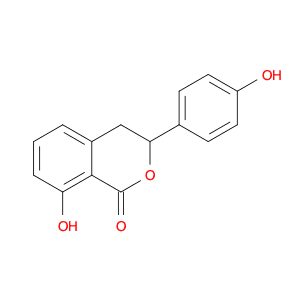
:3,4-Dihydro-8-hydroxy-3-(4-hydroxyphenyl)-1H-2-benzopyran-1-one
Description:
3,4-Dihydro-8-hydroxy-3-(4-hydroxyphenyl)-1H-2-benzopyran-1-one, commonly known as flavanone, is a naturally occurring compound belonging to the flavonoid class of phytochemicals. It exhibits a complex structure characterized by a benzopyran backbone, which contributes to its diverse biological activities. This compound is known for its antioxidant properties, which help in scavenging free radicals and reducing oxidative stress in biological systems. Additionally, it has been studied for its potential anti-inflammatory, antimicrobial, and anticancer effects, making it of interest in pharmacological research. The presence of hydroxyl groups enhances its solubility and reactivity, influencing its interaction with various biological targets. Its applications extend to food, cosmetics, and nutraceuticals, where it is valued for both its health benefits and its role as a natural colorant. Overall, 3,4-Dihydro-8-hydroxy-3-(4-hydroxyphenyl)-1H-2-benzopyran-1-one represents a significant compound in the study of natural products and their therapeutic potential.
Formula:C15H12O4
InChI:InChI=1S/C15H12O4/c16-11-6-4-9(5-7-11)13-8-10-2-1-3-12(17)14(10)15(18)19-13/h1-7,13,16-17H,8H2
InChI key:InChIKey=DGKDFNDHPXVXHW-UHFFFAOYSA-N
SMILES:O=C1C=2C(CC(O1)C3=CC=C(O)C=C3)=CC=CC2O
Synonyms:- 1H-2-benzopyran-1-one, 3,4-dihydro-8-hydroxy-3-(4-hydroxyphenyl)-
- 3,4-Dihydro-8-hydroxy-3-(4-hydroxyphenyl)-1H-2-benzopyran-1-one
- Hydrangenol
- Isocoumarin, 3,4-dihydro-8-hydroxy-3-(p-hydroxyphenyl)-
Sort by
Purity (%)
0
100
|
0
|
50
|
90
|
95
|
100
Found 5 products.
Ref: IN-DA00DGZ1
1mg204.00€5mg338.00€10mg672.00€25mgTo inquire50mgTo inquire100mgTo inquire500mgTo inquireHydrangenol
CAS:Hydrangenol, from Hydrangea serrata leaves, is an anti-wrinkle agent. It reduces MMP, inflammation, boosts moisture and antioxidants.Formula:C15H12O4Purity:99.7% - 99.88%Color and Shape:SolidMolecular weight:256.25Ref: TM-TN4234
1mg137.00€5mg304.00€10mg455.00€25mg745.00€50mg1,026.00€100mg1,406.00€500mg2,812.00€1mL*10mM (DMSO)314.00€Hydrangenol
CAS:Hydrangenol is a natural product that inhibits the activity of mitochondrial membrane potential, leading to cell death. This compound also has potent antitumor activity. It was shown to synergistically inhibit the growth of tumor cells with other compounds, such as coumarin derivatives, which have been shown to have an effect on light-induced skin cancer in mice. The mechanism of action is not fully understood, but it is thought that hydrangenol may bind to the hydroxyl group on the side chain of p-hydroxybenzoic acid and protocatechuic acid. Hydrangenol can be found bound to skin cells and has been shown to decrease MMP-9 activity in these cells.
Formula:C15H12O4Purity:Min. 95%Color and Shape:PowderMolecular weight:256.3 g/molRef: 3D-AAA48047
Discontinued product