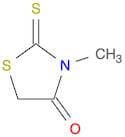
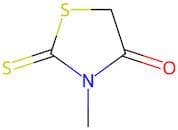
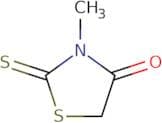
CAS 4807-55-0
:Methylrhodanine
Description:
Methylrhodanine, with the CAS number 4807-55-0, is a heterocyclic compound characterized by its rhodanine structure, which includes a five-membered ring containing sulfur and nitrogen atoms. This compound typically exhibits a yellow to orange color and is known for its potential applications in various fields, including pharmaceuticals and organic synthesis. Methylrhodanine is recognized for its ability to act as a building block in the synthesis of more complex molecules, often due to its electrophilic nature and the presence of functional groups that can participate in further chemical reactions. Additionally, it may exhibit biological activity, making it of interest in medicinal chemistry. The compound is soluble in organic solvents, and its stability can vary depending on environmental conditions such as pH and temperature. As with many chemical substances, safety precautions should be observed when handling methylrhodanine, as it may pose health risks if ingested or inhaled. Overall, methylrhodanine is a versatile compound with significant implications in chemical research and development.
Formula:C4H5NOS2
InChI:InChI=1S/C4H5NOS2/c1-5-3(6)2-8-4(5)7/h2H2,1H3
InChI key:InChIKey=JKLZCQWVERBDEZ-UHFFFAOYSA-N
SMILES:CN1C(=O)CSC1=S
Synonyms:- 3-Methyl-2-Thioxo-1,3-Thiazolidin-4-One
- 3-Methyl-2-sulfanylidene-1,3-thiazolidin-4-one
- 3-Methyl-2-thioxo-4-thiazolidinone
- 3-Methyl-2-thioxo-thiazolidin-4-on
- 4-Thiazolidinone, 3-methyl-2-thioxo-
- Brn 0113456
- Methylrhodanine
- N-Methylrhodanine
- Nsc 14787
- Nsc 42903
- Nsc 65351
- Rhodanine, 3-methyl-
- Rhodanine, N-methyl-
- Usaf T-2
- See more synonyms
Sort by
Purity (%)
0
100
|
0
|
50
|
90
|
95
|
100
Found 4 products.
3-methyl-2-thioxo-1,3-thiazolan-4-one
CAS:3-methyl-2-thioxo-1,3-thiazolan-4-onePurity:97%Molecular weight:147.22g/mol3-Methylrhodanine
CAS:3-Methylrhodanine is a tetronic acid that has been shown to be an inhibitor of a number of enzyme systems. 3-Methylrhodanine has been demonstrated to have acute toxicities in animals and humans, and it is amide-sensitive. The biological properties of 3-methylrhodanine have been studied by examining the effects on enzymes involved in the metabolism of cholesterol, steroid hormones, and amino acids. 3-Methylrhodanine has also been used as a surface-enhanced raman probe for detecting hydrogen bonds in organic molecules. It has been shown to bind to carbonyl groups and form coordination complexes with metals such as copper and zinc. This compound also forms intramolecular hydrogen bonds between its two hydroxyl groups.Formula:C4H5NOS2Purity:Min. 95%Molecular weight:147.22 g/mol