CAS 483-54-5
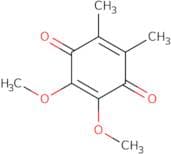
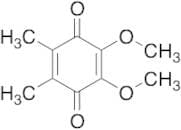
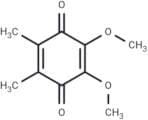
:2,3-dimethoxy-5,6-dimethylcyclohexa-2,5-diene-1,4-dione
Description:
2,3-Dimethoxy-5,6-dimethylcyclohexa-2,5-diene-1,4-dione, with CAS number 483-54-5, is an organic compound characterized by its unique bicyclic structure featuring two methoxy groups and two methyl groups attached to a cyclohexadiene framework. This compound exhibits a conjugated diene system, which contributes to its potential reactivity and stability under various conditions. The presence of the diketone functional groups (1,4-dione) indicates that it can participate in various chemical reactions, such as nucleophilic additions and condensation reactions. The methoxy groups enhance its solubility in organic solvents and may influence its electronic properties, making it a candidate for applications in organic synthesis and materials science. Additionally, the compound's structural features suggest potential biological activity, although specific biological properties would require further investigation. Overall, 2,3-dimethoxy-5,6-dimethylcyclohexa-2,5-diene-1,4-dione is a versatile compound with interesting chemical characteristics that warrant further exploration in both synthetic and applied chemistry contexts.
Formula:C10H12O4
InChI:InChI=1/C10H12O4/c1-5-6(2)8(12)10(14-4)9(13-3)7(5)11/h1-4H3
SMILES:CC1=C(C)C(=O)C(=C(C1=O)OC)OC
Synonyms:- 2,3-Dimethoxy-5,6-dimethyl-1,4-benzoquinone
- 2,3-Dimethoxy-5,6-dimethyl-2,5-cyclohexadiene-1,4-dione
- 2,5-Cyclohexadiene-1,4-Dione, 2,3-Dimethoxy-5,6-Dimethyl-
- Aurantiogliocladin
- 2,3-DIMETHOXY-5,6-DIMETHYL-P-BENZOQUINONE
Sort by
Purity (%)
0
100
|
0
|
50
|
90
|
95
|
100
Found 3 products.
2,3-Dimethoxy-5,6-dimethyl-p-benzoquinone
CAS:2,3-Dimethoxy-5,6-dimethyl-p-benzoquinone is an organic compound commonly known as a quinone derivative, often categorized under synthetic quinones. This compound is typically synthesized in the laboratory, derived from the structural modification of naturally occurring benzoquinones, which are found in various biological systems. Its mode of action primarily involves redox cycling due to its electron transfer capabilities, allowing it to participate in electron transport chains and redox reactions.Formula:C10H12O4Purity:Min. 95%Color and Shape:PowderMolecular weight:196.2 g/mol2,3-Dimethoxy-5,6-dimethyl-p-benzoquinone
CAS:Controlled ProductFormula:C10H12O4Color and Shape:NeatMolecular weight:196.2Aurantiogliocladin
CAS:Aurantiogliocladin is a mild antibiotic effective against Staphylococcus epidermidis, but it shows no efficacy against Staphylococcus aureus. It is also capable of inhibiting biofilm formation.Formula:C10H12O4Color and Shape:SolidMolecular weight:196.2