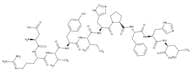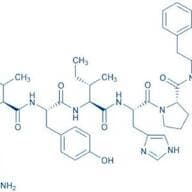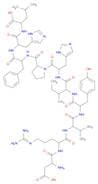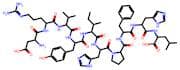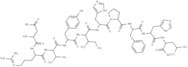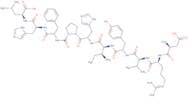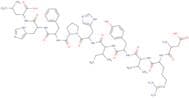
CAS 484-42-4
:Angiotensin I
Description:
Angiotensin I is a peptide hormone that plays a crucial role in the regulation of blood pressure and fluid balance in the body. It is a decapeptide, consisting of ten amino acids, and is derived from angiotensinogen, a precursor protein produced by the liver. Angiotensin I is biologically inactive but is converted into the active form, angiotensin II, by the action of the enzyme angiotensin-converting enzyme (ACE). This conversion is a key step in the renin-angiotensin system, which regulates blood pressure and electrolyte balance. Angiotensin I is characterized by its specific amino acid sequence, which includes proline and histidine residues, contributing to its structural properties. It is soluble in water and has a relatively short half-life in circulation, making it a transient component of the renin-angiotensin system. The study of angiotensin I and its derivatives is significant in pharmacology, particularly in the development of antihypertensive medications that target the renin-angiotensin system to manage conditions such as hypertension and heart failure.
Formula:C62H89N17O14
InChI:InChI=1/C62H89N17O14/c1-7-35(6)51(78-56(87)44(25-37-17-19-40(80)20-18-37)74-58(89)50(34(4)5)77-53(84)42(15-11-21-68-62(64)65)71-52(83)41(63)28-49(81)82)59(90)75-46(27-39-30-67-32-70-39)60(91)79-22-12-16-48(79)57(88)73-43(24-36-13-9-8-10-14-36)54(85)72-45(26-38-29-66-31-69-38)55(86)76-47(61(92)93)23-33(2)3/h8-10,13-14,17-20,29-35,41-48,50-51,80H,7,11-12,15-16,21-28,63H2,1-6H3,(H,66,69)(H,67,70)(H,71,83)(H,72,85)(H,73,88)(H,74,89)(H,75,90)(H,76,86)(H,77,84)(H,78,87)(H,81,82)(H,92,93)(H4,64,65,68)/t35-,41-,42-,43-,44-,45-,46-,47-,48-,50-,51-/m0/s1
SMILES:CC[C@H](C)[C@@H](C(=N[C@@H](Cc1cnc[nH]1)C(=O)N1CCC[C@H]1C(=N[C@@H](Cc1ccccc1)C(=N[C@@H](Cc1cnc[nH]1)C(=N[C@@H](CC(C)C)C(=O)O)O)O)O)O)N=C([C@H](Cc1ccc(cc1)O)N=C([C@H](C(C)C)N=C([C@H](CCCNC(=N)N)N=C([C@H](CC(=O)O)N)O)O)O)O
Synonyms:- H-Asp-Arg-Val-Tyr-Ile-His-Pro-Phe-His-Leu-OH
- L-alpha-aspartyl-N~5~-(diaminomethylidene)-L-ornithyl-L-valyl-L-tyrosyl-L-isoleucyl-L-histidyl-L-prolyl-L-phenylalanyl-L-histidyl-L-leucine
Sort by
Purity (%)
0
100
|
0
|
50
|
90
|
95
|
100
Found 10 products.
Angiotensin I (human)
CAS:Angiotensin I (human) stimulates the release of aldosterone, another hormone, from the adrenal cortex. It acts as a precursor to angiotensin II. It acts as endogenous peptide substrate for angiotensin converting enzyme (ACE), precursor to the vasoconstrictor peptide angiotensin II This Thermo ScientFormula:C62H89N17O14Color and Shape:White to off-white, Powder or crystals or crystalline powderMolecular weight:1296.50Angiotensin I
CAS:Angiotensin I, DRVYIHPFHL, is cleaved by angiotensin-converting enzyme (ACE) yielding Ang II and the dipeptide His-Leu. Ang I is also converted to Ang II by chymase, especially in the human heart. Hence, this mast cell protease is also involved in blood pressure regulation. The chymase pathway gains importance in inflammatory conditions.Formula:C62H89N17O14Purity:97.9%Color and Shape:WhiteMolecular weight:1296.5Angiotensin 1, Human
CAS:Formula:C62H89N17O14Purity:98%Color and Shape:SolidMolecular weight:1296.4756Angiotensin I (human, mouse, rat)
CAS:Angiotensin I (human, mouse, rat)Purity:≥98%Molecular weight:1296.48g/molAngiotensin I (human, mouse, rat)
CAS:Angiotensin I (human, mouse, rat) is the precursor to the vasoconstrictor peptide angiotensin II, cleaved by the angiotensin-converting enzyme (ACE).Formula:C62H89N17O14Purity:>99.99%Color and Shape:SolidMolecular weight:1296.48Angiotensin I
CAS:The renin angiotensin system (RAS), consists of many angiotensin peptides involved in regulating functions such as blood pressure, cardiovascular function and energy balance. RAS activity is elevated in obesity and RAS is widely studied in relation to lifestyle-related diseases.Angiotensin I (Ang-I), is the first angiotensin to be produced upon activation of the RAS system. It is produced by the cleavage of angiotensinogen (AGT), catalysed by the aspartylprotease, renin. The dicarboxyl-peptidase angiotensin converting enzyme (ACE), then removes two amino acids from the C-terminus of Ang-I to form angiotensin II (Ang-II), and His-Leu.Ang-I is also converted to Ang-II by chymase, especially in the human heart. The chymase pathway is important in inflammatory conditions.Formula:C62H89N17O14Molecular weight:1,296.48 g/molAngiotensin I, human
CAS:Angiotensin I is a protein encoded by the AGTR1 gene. It is a precursor to angiotensin II, which causes vasoconstriction and has other effects on blood vessels, kidneys, and the heart. Angiotensin I is produced by proteolytic cleavage of pro-angiotensinogen in the liver. The mouse monoclonal antibody to human angiotensin I (mAb-HAI) recognizes both human and bovine angiotensin I. This antibody can be used for immunohistochemistry or Western blot analysis of cells from mice that have been injected with mAb-HAI. It has also been shown to reduce kidney fibrosis in mice when it is administered as a subcutaneous injection three times per week.Formula:C62H89N17O14Purity:Min. 95%Molecular weight:1,296.48 g/molAngiotensin I (Human)
CAS:Angiotensin I (Human) is a peptide that functions as a hormone. It is the major regulator of blood pressure and plays an important role in the regulation of fluid balance, electrolyte balance, and heart rate. Angiotensin I (Human) is a receptor ligand that binds to cell surface receptors which are coupled to G proteins. It has been used extensively as a research tool for studying protein interactions and ion channels.
Formula:C62H89N17O14Purity:Min. 95%Molecular weight:1,296.5 g/molAngiotensin I (Human)
CAS:Angiotensin I (Human) is a protein that is found in the blood and other tissues. It is a peptide hormone, which acts on the kidneys to increase blood pressure and on the heart to increase cardiac output. This protein has been detected in several biological samples such as plasma, serum, or urine. Angiotensin I (Human) can be used as an enzyme form of angiotensin 1-converting enzyme (ACE). ACE catalyzes the conversion of angiotensin I to its active form, angiotensin II. Angiotensin II has been shown to reduce the production of inflammatory cytokines such as tumor necrosis factor-alpha and interleukins. It also stimulates vascular smooth muscle cells and increases the production of nitric oxide by these cells, leading to vasodilation. The measurement of this enzyme form in a sample may help determine disease activity in patients with bowel disease or squamous cell cancer of the skin.Formula:C62H89N17O14•2CH3COOH•4H2OPurity:Min. 95%Molecular weight:1,488.66 g/molAngiotensin I, human
CAS:Custom research peptide; min purity 95%. For different specs please use the Peptide Quote Tool
Formula:C62H89N17O14Molecular weight:1,296.5 g/mol