CAS 4843-98-5
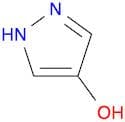
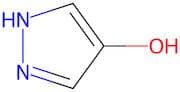
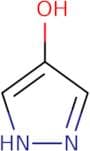
:1H-pyrazol-4-ol
Description:
1H-pyrazol-4-ol, also known as 4-hydroxypyrazole, is an organic compound characterized by its pyrazole ring structure with a hydroxyl group at the 4-position. This compound typically appears as a white to off-white crystalline solid and is soluble in polar solvents such as water and alcohols. It exhibits a range of interesting chemical properties, including the ability to act as a weak acid due to the presence of the hydroxyl group, which can participate in hydrogen bonding. 1H-pyrazol-4-ol is often utilized in various chemical syntheses and has applications in pharmaceuticals, agrochemicals, and as a reagent in organic chemistry. Its derivatives may exhibit biological activity, making it of interest in medicinal chemistry. The compound's stability and reactivity can be influenced by substituents on the pyrazole ring, allowing for the design of tailored compounds for specific applications. Safety data should be consulted for handling and storage, as with all chemical substances.
Formula:C3H4N2O
InChI:InChI=1/C3H4N2O/c6-3-1-4-5-2-3/h1-2,6H,(H,4,5)
InChI key:InChIKey=KAUABWYBFARJAF-UHFFFAOYSA-N
SMILES:OC=1C=NNC1
Synonyms:- 4-Hydroxy-1H-pyrazole
- 4-Hydroxypyrazole
- Pyrazol-4-ol
- 1H-Pyrazol-4-ol
- 4-Hydroxypyrazol
- 4-HP
- InChI=1/C3H4N2O/c6-3-1-4-5-2-3/h1-2,6H,(H,4,5
Sort by
Purity (%)
0
100
|
0
|
50
|
90
|
95
|
100
Found 6 products.
1H-Pyrazol-4-ol
CAS:<p>1H-Pyrazol-4-ol is a molecule that has been shown to have antibacterial properties by inhibiting the growth of bacteria. It was also found to be effective in inhibiting the activity of dopamine β-hydroxylase, which is an enzyme that catalyzes the conversion of dopamine to norepinephrine. 1H-Pyrazol-4-ol has been shown to inhibit nitrite ion reductase, which converts nitrite ions into nitric oxide. Nitric oxide is a potent vasodilator and can cause hypotension. 1H-Pyrazol-4-ol also inhibits the formation of nitro groups from diazonium salts, which are used in many industrial processes, including dyeing and photography. 1H-Pyrazol-4-ol is activated by UV light and reacts with epididymal adipose tissue (fatty tissue) in rats to generate pyrazole derivatives with cytotoxic effects on liver</p>Formula:C3H4N2OPurity:Min. 95%Molecular weight:84.08 g/mol