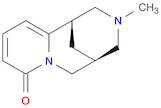
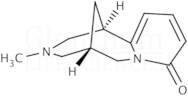
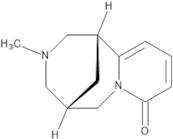
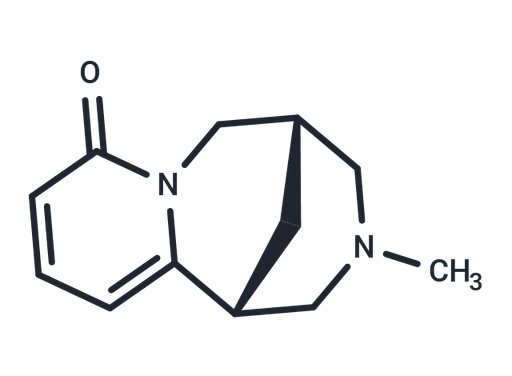
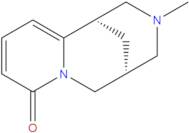
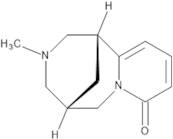
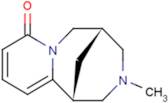
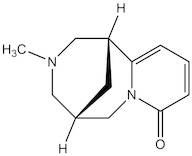
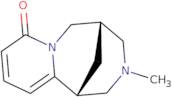
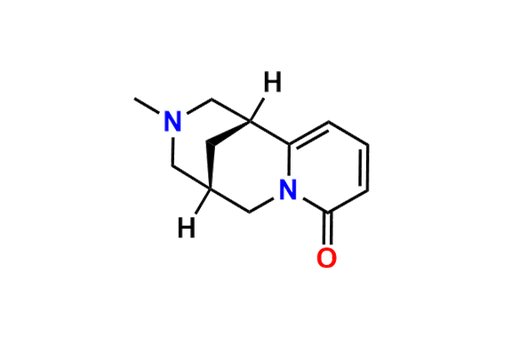
CAS 486-86-2
:(-)-N-Methylcytisine
Description:
(-)-N-Methylcytisine is an alkaloid derived from the plant Cytisus laburnum, commonly known as the golden chain tree. It is characterized by its structural similarity to nicotine, featuring a pyridine ring and a piperidine moiety. This compound is known for its potential pharmacological effects, particularly as a partial agonist at nicotinic acetylcholine receptors, which may influence its use in smoking cessation therapies. (-)-N-Methylcytisine exhibits a chiral center, resulting in its specific enantiomeric form, which is biologically active. The substance is typically a white to off-white crystalline solid and is soluble in polar solvents. Its molecular formula includes carbon, hydrogen, and nitrogen atoms, reflecting its organic nature. Due to its biological activity, it has garnered interest in research related to neuropharmacology and addiction. However, safety and toxicity profiles should be considered when handling or using this compound in any application.
Formula:C12H16N2O
InChI:InChI=1S/C12H16N2O/c1-13-6-9-5-10(8-13)11-3-2-4-12(15)14(11)7-9/h2-4,9-10H,5-8H2,1H3/t9-,10+/m0/s1
InChI key:InChIKey=CULUKMPMGVXCEI-VHSXEESVSA-N
SMILES:O=C1N2C([C@@]3(C[C@](C2)(CN(C)C3)[H])[H])=CC=C1
Synonyms:- (1R)-11-Methyl-7,11-diazatricyclo[7.3.1.0~2,7~]trideca-2,4-dien-6-one
- (1R)-3-methyl-1,2,3,4,5,6-hexahydro-8H-1,5-methanopyrido[1,2-a][1,5]diazocin-8-one
- (1R,5S)-1,2,3,4,5,6-Hexahydro-3-methyl-1,5-methano-8H-pyrido[1,2-a][1,5]diazocin-8-one
- (1S,5S)-3-methyl-1,2,3,4,5,6-hexahydro-8H-1,5-methanopyrido[1,2-a][1,5]diazocin-8-one
- 1,2,3,4,5,6-Hexahydro-3-methyl-1,5-methano-8H-pyrido[1,2-a][1,5]diazocin-8-one
- 1,5-Methano-8H-pyrido[1,2-a][1,5]diazocin-8-one, 1,2,3,4,5,6-hexahydro-3-methyl-, (1R,5S)-
- 1,5-methano-8H-pyrido[1,2-a][1,5]diazocin-8-one, 1,2,3,4,5,6-hexahydro-3-methyl-
- 1,5-methano-8H-pyrido[1,2-a][1,5]diazocin-8-one, 1,2,3,4,5,6-hexahydro-3-methyl-, (1R)-
- 3-Methylcytisine
- 3-methyl-1,2,3,4,5,6-hexahydro-8H-1,5-methanopyrido[1,2-a][1,5]diazocin-8-one
- Caulophyllin
- Caulophylline
- Cytisine, 12-methyl-
- Cytisine, N-methyl-
- Cytisine, methyl-
- See more synonyms
Filter by
Purity percentage
0
100
|
0
|
50
|
90
|
95
|
100
Found 15 products.
- Lower prices
- Higher prices
- Lower purities
- Higher purities
- Faster estimated delivery
N-Methylcytisine
CAS:N-MethylcytisineFormula:C12H16N2OPurity:≥98%Color and Shape:SolidMolecular weight:204.27(-)-N-Methylcytisine
CAS:Controlled ProductFormula:C12H16N2OColor and Shape:NeatMolecular weight:204.27N-Methylcytisine (Standard)
CAS:N-Methylcytisine (Standard) is a reference standard for research and analysis in studies involving N-Methylcytisine. 1. N-Methylcytisine (Caulophylline)'s nicotinic receptors have high affinity (KD = 5 nM)to nAChR from squid optical ganglia. 2. N-Methylcytisine and N, N-dimethylcytisine did not displace 14C-tubocurarine at a concentration of .1 mM, cytisine was the only effective inhibitor of 14C-tubocurarine specific binding (Ki=7 nM).Formula:C12H16N2OColor and Shape:SolidMolecular weight:204.27N-Methylcytisine
CAS:Applications N-Methylcytisine (cas# 486-86-2) is a compound useful in organic synthesis.
Formula:C12H16N2OColor and Shape:NeatMolecular weight:204.27N-Methylcytisine
CAS:N-Methylcytisine binds strongly (KD=5nM) to squid nAChR, only cytisine inhibits 14C-tubocurarine (Ki=7nM), not other derivatives.Formula:C12H16N2OPurity:99.83% - 99.89%Color and Shape:SolidMolecular weight:204.27N-Methylcytisine
CAS:(1R,5S)-3-Methyl-3,4,5,6-tetrahydro-1H-1,5-methanopyrido[1,2-a][1,5]diazocin-8(2H)-oneFormula:C12H16N2OPurity:98%Molecular weight:204.27N-Methylcytisine
CAS:Natural alkaloidFormula:C12H16N2OPurity:≥ 95.0 % (HPLC)Color and Shape:PowderMolecular weight:204.27N-Methylcytisine
CAS:N-Methylcytisine is a drug that is used to treat bowel disease, locomotor activity, and hypoglycemia. This drug has been shown to have significant cytotoxicity in vitro against squamous carcinoma cells. N-Methylcytisine also inhibits the production of gamma-aminobutyric acid (GABA) and reduces the activity index in anagyroides. This drug has been shown to have a significant effect on colitis and other inflammatory bowel diseases in vivo by reducing inflammation and increasing mucin production.Formula:C12H16N2OPurity:Min. 98 Area-%Color and Shape:White PowderMolecular weight:204.27 g/mol