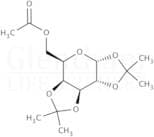
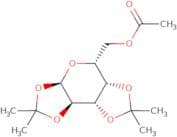
![(2,2,7,7-tetramethyltetrahydro-3aH-bis[1,3]dioxolo[4,5-b:4',5'-d]pyran-5-yl)methyl acetate (non-pr…](/_next/image/?url=https%3A%2Fstatic.cymitquimica.com%2Fcas-image%2Fthumb-webp%2F287485-2277-tetramethyltetrahydro-3ah-bis-13-dioxolo-45-b-4-5-d-pyran-5-yl-methyl-acetate-non-preferred-name.webp&w=3840&q=75)
CAS 4860-78-0
:(2,2,7,7-tetramethyltetrahydro-3aH-bis[1,3]dioxolo[4,5-b:4',5'-d]pyran-5-yl)methyl acetate (non-preferred name)
Description:
The chemical substance known as (2,2,7,7-tetramethyltetrahydro-3aH-bis[1,3]dioxolo[4,5-b:4',5'-d]pyran-5-yl)methyl acetate, with the CAS number 4860-78-0, is a complex organic compound characterized by its unique structural features. It contains multiple dioxole rings, which contribute to its potential reactivity and stability. The presence of acetate functional groups suggests that it may exhibit ester-like properties, influencing its solubility and reactivity in various solvents. This compound is likely to be a colorless to pale yellow liquid or solid, depending on its specific formulation and purity. Its molecular structure indicates potential applications in fields such as organic synthesis, pharmaceuticals, or as a flavoring agent, although specific applications may vary. The compound's stability, reactivity, and potential toxicity would need to be evaluated through experimental studies to fully understand its behavior in different environments. Overall, this substance exemplifies the complexity and diversity of organic compounds in chemical research.
Formula:C14H22O7
InChI:InChI=1/C14H22O7/c1-7(15)16-6-8-9-10(19-13(2,3)18-9)11-12(17-8)21-14(4,5)20-11/h8-12H,6H2,1-5H3
SMILES:CC(=O)OCC1C2C(C3C(O1)OC(C)(C)O3)OC(C)(C)O2
Sort by
Purity (%)
0
100
|
0
|
50
|
90
|
95
|
100
Found 2 products.
6-O-Acetyl-1,2:3,4-di-O-isopropylidene-α-D-galactopyranose
CAS:Glycosylation is the chemical process of adding sugars to other molecules. It often occurs in the cell, but can also be done in a lab. The process of glycosylation is called O-glycosylation when it attaches a carbohydrate molecule to an amino acid or protein, and it's called N-glycosylation when it attaches a carbohydrate molecule to nitrogen-containing compounds such as proteins or nucleic acids. 6-O-Acetyl-1,2:3,4-di-O-isopropylidene-a-D-galactopyranose is a synthetic compound that is used as an intermediate in the synthesis of glycoproteins and other complex carbohydrates. This product has been modified by fluorination and acetylation. It has been shown to inhibit cancer cell proliferation, induce apoptosis (cell death), and increase chemosensitivity in cancer cells.Formula:C14H22O7Purity:Min. 95%Molecular weight:302.32 g/mol