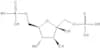
CAS 488-69-7
:Fructose 1,6-bisphosphate
Description:
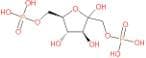
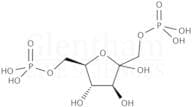
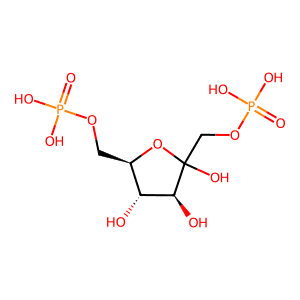
Fructose 1,6-bisphosphate (FBP) is a crucial intermediate in the glycolytic pathway, playing a significant role in cellular metabolism. It is a phosphorylated sugar, specifically a hexose, derived from fructose. The compound features two phosphate groups attached to the first and sixth carbon atoms, which are essential for its function in energy production. FBP is a colorless, water-soluble compound, and its structure allows it to participate in various enzymatic reactions, particularly those catalyzed by aldolase and fructose-1,6-bisphosphatase. It acts as an allosteric regulator, influencing the activity of key enzymes in metabolic pathways, thereby playing a role in the regulation of gluconeogenesis and glycolysis. The presence of the phosphate groups contributes to its high-energy characteristics, making it a vital molecule in energy transfer processes within cells. Additionally, FBP is involved in the regulation of metabolic flux and is a key player in the balance between energy production and consumption in living organisms.
Formula:C6H14O12P2
InChI:InChI=1S/C6H14O12P2/c7-3(1-17-19(11,12)13)5(9)6(10)4(8)2-18-20(14,15)16/h3,5-7,9-10H,1-2H2,(H2,11,12,13)(H2,14,15,16)/t3-,5-,6-/m1/s1
InChI key:InChIKey=XPYBSIWDXQFNMH-UYFOZJQFSA-N
SMILES:[C@H]([C@@H](C(COP(=O)(O)O)=O)O)([C@@H](COP(=O)(O)O)O)O
Synonyms:- 1,6-Bis(dihydrogenophosphate) de D-fructose
- 1,6-bis(dihidrogenofosfato) de D-fructosa
- 1,6-di-O-phosphono-D-fructofuranose
- 1,6-di-O-phosphono-D-fructose
- 1,6-di-O-phosphono-beta-D-fructofuranose
- 1,6-di-O-phosphonohex-2-ulofuranose
- 2,5-anhydro-1,6-di-O-phosphono-D-glucitol
- <span class="text-smallcaps">D</span>-Fructose 1,6-biphosphate
- <span class="text-smallcaps">D</span>-Fructose 1,6-bisphosphate
- <span class="text-smallcaps">D</span>-Fructose 1,6-diphosphate
- <span class="text-smallcaps">D</span>-Fructose, 1,6-bis(dihydrogen phosphate)
- D-Fructose 1,6-biphosphate
- D-Fructose 2,6-Diphosphate Di-Sodium Salt
- D-Fructose-1,6-bis(dihydrogenphosphat)
- D-fructose 1,6-bis(dihydrogen phosphate)
- D-fructose 1,6-bisphosphate
- Diphosphofructose
- Esafosfan
- Esafosfina
- F1,6diP
- FDP
- Fosfructose
- Fructose 1,6-bis(dihydrogen phosphate)
- Fructose 1,6-diphosphate
- Fructose Diphosphate
- Fructose, 1,6-bis(dihydrogen phosphate), <span class="text-smallcaps">D</span>-
- Fructose, 1,6-bis(dihydrogen phosphate), D-
- Fructose-1,6-Bisphosphate
- Harden-Young ester
- beta-D-fructofuranose-1,6-diphosphate
- See more synonyms
Sort by
Purity (%)
0
100
|
0
|
50
|
90
|
95
|
100
Found 10 products.
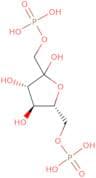
{[(3S,4S,5R)-2,3,4-trihydroxy-5-[(phosphonooxy)methyl]oxolan-2-yl]methoxy}phosphonic acid
CAS:Formula:C6H14O12P2Purity:95%Color and Shape:SolidMolecular weight:340.1157D-Fructose-1,6-diphosphate
CAS:D-Fructose-1,6-diphosphateFormula:C6H14O12P2Purity:95%Color and Shape:SolidMolecular weight:340.11568Fosfructose
CAS:D-fructose-1,6-diphosphate (D-fructose-1,6-diphosphate), also known as Fosfructose, is a cytoprotective natural sugar phosphate.Formula:C6H14O12P2Purity:99.84%Color and Shape:SolidMolecular weight:340.12D-Fructose-13C6 1,6-Bisphosphate Sodium Salt Hydrate
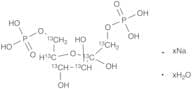
CAS:Controlled ProductApplications Isotope labelled Fructose1,6-bisphosphate is an intermediate that lies within the glycolysis metabolic pathway and is also an allosteric activator of pyruvate kinase.
References Hinder, L.M., et al.: J. Endocriol., 216, 1 (2013); Takubo, K., et al.: Cell. Stem. Cell., 12, 49 (2013); Kalam, Y., et al.: Clin. Toxciol., 50, 546 (2012);Formula:C6H14O12P2•xH2O•xNaColor and Shape:NeatMolecular weight:346.06D-Fructose-1,6-diphosphate
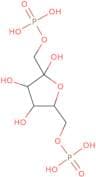
CAS:D-Fructose-1,6-diphosphate is a chemical that is found in the cytosol of cells. It is an intermediate in the metabolism of fructose and also has an important role in the synthesis of fatty acids and phospholipids. D-Fructose-1,6-diphosphate is an effective inhibitor of sodium succinate dehydrogenase, which converts succinate to fumarate. D-Fructose-1,6-diphosphate has a neutral pH profile and is not affected by changes in pH levels. The optimum pH for this compound is between 6.5 and 7.5. D-Fructose-1,6-diphosphate binds to proteins with unsaturated alkyl chains such as creatine kinase and glutamate dehydrogenase. It has been shown to have hemolytic effects on erythrocytes (red blood cells) at high concentrations, which may be due to its ability to bindFormula:C6H14O12P2Purity:(¹H-Nmr) Min. 95 Area-%Color and Shape:White PowderMolecular weight:340.12 g/molD-FRUCTOFURANOSE 1,6-BISPHOSPHATE
CAS:Formula:C6H14O12P2Purity:≥98.0%Color and Shape:Liquid, No data available.Molecular weight:339.996D-Fructose-2-13C2 1,6-Bisphosphate Tetrasodium Salt Hydrate
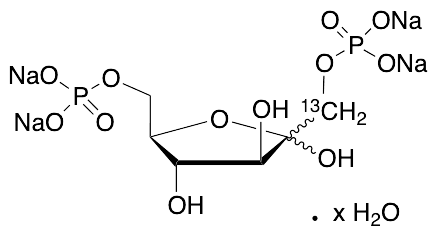
CAS:Controlled ProductApplications Isotope labelled Fructose1,6-bisphosphate is an intermediate that lies within the glycolysis metabolic pathway and is also an allosteric activator of pyruvate kinase.
References Hinder, L.M., et al.: J. Endocriol., 216, 1 (2013); Takubo, K., et al.: Cell. Stem. Cell., 12, 49 (2013); Kalam, Y., et al.: Clin. Toxciol., 50, 546 (2012);Formula:C513CH10Na4O12P2•xH2OColor and Shape:NeatMolecular weight:429.03D-Fructose-13C6-1,6-diphosphate sodium salt
CAS:D-Fructose-13C6-1,6-diphosphate sodium salt is a reactive compound used as a model in studies of metabolic disorders. It has been shown to have an inhibitory effect on the enzymes that catalyze the conversion of D-fructose 1,6 diphosphate to D-fructose 6 phosphate in the cytosol. The compound is also useful for determining the binding of calcium ions to proteins and for measuring the activity of carbon source enzymes.Formula:C6H10Na4O12P2·xH2OPurity:Min. 95%Color and Shape:PowderMolecular weight:434 g/mol
![{[(3S,4S,5R)-2,3,4-trihydroxy-5-[(phosphonooxy)methyl]oxolan-2-yl]methoxy}phosphonic acid](/_next/image/?url=https%3A%2Fstatic.cymitquimica.com%2Fproducts%2FIN%2Fthumb%2FDA00393R.jpg&w=3840&q=75)