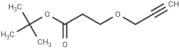
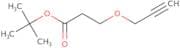
CAS 488150-84-1
:Propanoic acid, 3-(2-propynyloxy)-, 1,1-dimethylethyl ester
Description:
Propanoic acid, 3-(2-propynyloxy)-, 1,1-dimethylethyl ester, identified by CAS number 488150-84-1, is an organic compound characterized by its ester functional group. This compound features a propanoic acid backbone, which is a three-carbon carboxylic acid, and is modified with a propynyloxy group at the third carbon position, contributing to its unique reactivity and properties. The presence of the tert-butyl group (1,1-dimethylethyl) enhances its steric bulk, which can influence its solubility and stability. Generally, esters like this one are known for their pleasant odors and are often used in flavoring and fragrance applications. Additionally, the compound may exhibit moderate polarity due to the carboxylic acid moiety, affecting its solubility in various solvents. Its potential applications could span across fields such as organic synthesis, pharmaceuticals, and agrochemicals, depending on its reactivity and functional properties. As with many organic compounds, safety data should be consulted for handling and usage guidelines.
Formula:C10H16O3
Sort by
Purity (%)
0
100
|
0
|
50
|
90
|
95
|
100
Found 5 products.
Propanoic acid, 3-(2-propynyloxy)-, 1,1-dimethylethyl ester
CAS:Formula:C10H16O3Purity:97%Color and Shape:LiquidMolecular weight:184.2322Ref: IN-DA00I8TA
25gTo inquire50gTo inquire75gTo inquire100gTo inquire250mg40.00€1g64.00€5g195.00€10g276.00€15g586.00€Propargyl-PEG1-Boc
CAS:Propargyl-PEG1-Boc is an alkyl/ether-based linker employed for the synthesis of PROTACs[1].Formula:C10H16O3Purity:98%Color and Shape:SolidMolecular weight:184.2322Propargyl-PEG1-t-butyl ester
CAS:Propargyl-PEG1-t-butyl ester is a PEG compound with two different functional groups (also known as heterobifunctional). Unlike homobifunctional PEG compounds (same functional group on both ends), this type of compounds are more versatile as have two different anchor points. Propargyl-PEG1-t-butyl ester is used as a linker and spacer to add a PEG moiety, via pegylation (a bioconjugation technique) to proteins, peptides, oligonucleotides, small molecules and nanoparticles.
Formula:C10H16O3Purity:Min. 95%Molecular weight:184.23 g/mol