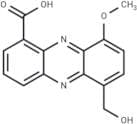
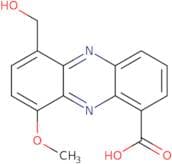
CAS 489-76-9
:6-(hydroxymethyl)-9-methoxyphenazine-1-carboxylic acid
Description:
6-(Hydroxymethyl)-9-methoxyphenazine-1-carboxylic acid, with the CAS number 489-76-9, is a chemical compound belonging to the phenazine family, characterized by its unique structure that includes a phenazine core substituted with various functional groups. This compound features a hydroxymethyl group and a methoxy group, which contribute to its solubility and reactivity. It is typically a solid at room temperature and may exhibit moderate stability under standard conditions. The presence of the carboxylic acid functional group suggests that it can participate in acid-base reactions and may act as a weak acid. This compound is of interest in various fields, including organic synthesis and medicinal chemistry, due to its potential biological activities. Its derivatives may exhibit antimicrobial or antitumor properties, making it a subject of research in pharmacology. As with many organic compounds, handling should be done with care, considering safety data and potential hazards associated with its use.
Formula:C15H12N2O4
InChI:InChI=1/C15H12N2O4/c1-21-11-6-5-8(7-18)12-14(11)17-13-9(15(19)20)3-2-4-10(13)16-12/h2-6,18H,7H2,1H3,(H,19,20)
SMILES:COc1ccc(CO)c2c1nc1c(cccc1n2)C(=O)O
Sort by
Purity (%)
0
100
|
0
|
50
|
90
|
95
|
100
Found 2 products.
Griseoluteic acid
CAS:Griseoluteic acid is a breakdown product of griseolutein A and B. Griseoluteic acid is a phenazine antibiotic and is originally isolated from S. griseoluteus.Formula:C15H12N2O4Purity:98%Color and Shape:SolidMolecular weight:284.27Griseoluteic acid
CAS:Griseoluteic acid is a cyclic lipopeptide that inhibits bacterial growth by binding to the enzyme cyclase, which is involved in the production of cyclic AMP. Griseoluteic acid also inhibits the synthesis of rRNA (ribosomal RNA), which is required for protein synthesis. The compound has been shown to have a high degree of resistance against antibiotic-resistant strains and exhibits a low toxicity profile in vitro. Griseoluteic acid also has an inhibitory effect on hydrogen bonding interactions, which may be due to its ability to inhibit energy metabolism. This compound also exhibits anti-inflammatory properties and has been shown to have neurodevelopmental effects in animal models.
Formula:C15H12N2O4Purity:Min. 95%Molecular weight:284.27 g/mol