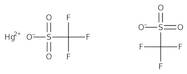
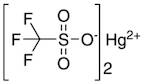
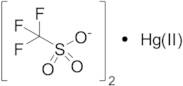
CAS 49540-00-3
:mercury(ii) trifluoromethanesulphonate
- Mercury(II) trifluoromethanesulfonate
- MercurytrifluoromethanesulfonateMercurytriflatepowder
- Mercury Bis(Trifluoromethanesulfonate)
- Lower prices
- Higher prices
- Lower purities
- Higher purities
- Faster estimated delivery
Mercury(II) trifluoromethanesulfonate, 98%
CAS:Hg(OTf)2 exhibits remarkable catalytic activity for the hydroxylative cyclization of 1,6-enynes. Mercuric triflate is a very versatile reagent and has been used for several organic catalytic transformations including C-C bond forming cyclizations, alkyne hydrations, heterocycle synthesis and very rFormula:C2F6HgO6S2Purity:98%Molecular weight:498.72Mercury(II) trifluoromethanesulfonate, 98% (Mercury triflate)
CAS:Mercury(II) trifluoromethanesulfonate, 98% (Mercury triflate)
Formula:Hg(CF3SO3)2Purity:98%Color and Shape:white pwdr.Molecular weight:498.71Mercury(2+);trifluoromethanesulfonate
CAS:Controlled ProductMercury(II) trifluoromethanesulfonate is a salt of mercury and triflate. It is a catalyst for the organic synthesis of coumarin derivatives, which are used as pharmaceuticals and in the preparation of dyes. The mercury(II) trifluoromethanesulfonate can also be used to catalyze the metathesis reaction between amines and alkynes. In addition, it has been shown to activate a variety of cationic polymerization reactions, including cationic ring-opening polymerization (CROP) and atom transfer radical polymerization (ATRP). Mercury(II) trifluoromethanesulfonate forms an equilibrium with mercury(0) in water, but its redox potential is higher than that of mercury. This property makes it useful as a synthetic pathway for preparing amines.
Formula:C2F6HgO6S2Purity:Min. 95%Molecular weight:498.73 g/molMercury(II) Triflate (2:1)
CAS:Controlled ProductFormula:(CF3O3S·HgColor and Shape:NeatMolecular weight:498.7