CAS 49557-75-7
:Glycyl-L-histidyl-L-lysine
Description:
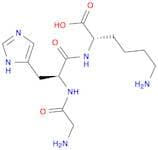
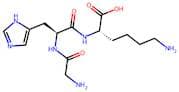
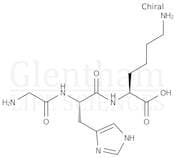
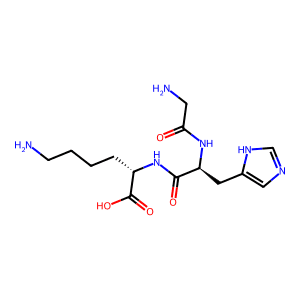
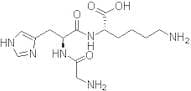
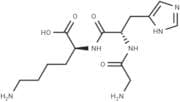
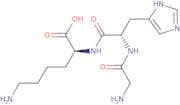
Glycyl-L-histidyl-L-lysine, with the CAS number 49557-75-7, is a tripeptide composed of three amino acids: glycine, histidine, and lysine. This compound is characterized by its peptide bond formation, which links the amino acids in a specific sequence. Glycyl-L-histidyl-L-lysine exhibits properties typical of peptides, including solubility in water and the ability to form hydrogen bonds due to the presence of polar side chains. The histidine residue contributes to its buffering capacity, making it potentially useful in biological systems where pH regulation is important. Additionally, lysine's positive charge at physiological pH can influence the peptide's interactions with other biomolecules, such as proteins and nucleic acids. This tripeptide may also play a role in various biological processes, including cell signaling and metabolism. Its stability and reactivity can be affected by environmental conditions, such as pH and temperature, which are crucial for its applications in biochemical research and potential therapeutic uses.
Formula:C14H24N6O4
InChI:InChI=1S/C14H24N6O4/c15-4-2-1-3-10(14(23)24)20-13(22)11(19-12(21)6-16)5-9-7-17-8-18-9/h7-8,10-11H,1-6,15-16H2,(H,17,18)(H,19,21)(H,20,22)(H,23,24)/t10-,11-/m0/s1
InChI key:InChIKey=MVORZMQFXBLMHM-QWRGUYRKSA-N
SMILES:[C@H](CC1=CN=CN1)(C(N[C@@H](CCCCN)C(O)=O)=O)NC(CN)=O
Synonyms:- 12: PN: FR2857667 SEQID: 8 claimed protein
- 13: PN: FR2857597 PAGE: 15 claimed protein
- 15: PN: KR20190032250 SEQID: 15 claimed protein
- 18: PN: KR20150027940 SEQID: 19 claimed protein
- 18: PN: WO0004941 PAGE: 31 claimed protein
- 24: PN: KR20090132815 PAGE: 3 claimed protein
- 24: PN: KR20090132911 SEQID: 119 claimed protein
- 2: PN: KR20140126802 SEQID: 2 claimed protein
- 4: PN: WO2020009548 SEQID: 4 claimed protein
- 59: PN: WO2012103038 SEQID: 61 unclaimed protein
- 8: PN: WO2007068998 SEQID: 2 unclaimed protein
- 9: PN: US20030229017 PAGE: 13 claimed protein
- <span class="text-smallcaps">L</smallcap>-Lysine, N<sup>2</sup>-(N-glycyl-<smallcap>L</span>-histidyl)-
- <span class="text-smallcaps">L</smallcap>-Lysine, glycyl-<smallcap>L</span>-histidyl-
- Copper glycyl-histidyl-lysine
- Copper peptide
- Copper(II)ghk
- GHK Tripeptide
- GHK-Cu
- Gly-his-lys
- Glycyl-<span class="text-smallcaps">L</smallcap>-histidyl-<smallcap>L</span>-lysine
- Glycyl-histidyl-lysine
- Glycylhistidyllysine
- Growth-modulating peptide
- Growth-modulating peptide (human)
- Iamin
- Kollaren
- Liver cell growth factor
- Liver growth factor
- N(2)-(N-Glycyl-L-histidyl)-L-lysine
- Nsc 379527
- Glycyl-L-histidyl-L-lysine
- L-Lysine, N2-(N-glycyl-L-histidyl)-
- See more synonyms
Sort by
Purity (%)
0
100
|
0
|
50
|
90
|
95
|
100
Found 9 products.
L-Lysine, glycyl-L-histidyl-
CAS:Formula:C14H24N6O4Purity:97%Color and Shape:SolidMolecular weight:340.3782Glycyl-L-Histidyl-L-Lysine
CAS:Glycyl-L-histidyl-L-lysine is a liver cell growth factor and an asynthetic hepatotrophic agent that stimulates hepatic erythropoietic factor production.Formula:C14H24N6O4Purity:99.52% - >99.99%Color and Shape:White PowderMolecular weight:340.38GHK tripeptide
CAS:The GHK tripeptide has many attributes which can positively impact human health. GHK can improve tissue repair, exhibit anti-cancer and anti-inflammatory properties, suppress age related molecules and restore chronic obstructive pulmonary disease fibroblasts.The GHK tripeptide is found in the human plasma and binds copper. It exerts its effects through its ability to up regulate and downregulate 4,000 human genes. Due to its ability to protect and regenerate aspects of human health, GHK-Cu can be used in products for skin and hair.Specifically during skin regeneration GHK-Cu can promote the synthesis of collagen and glycosaminoglycans, increase the rate of wound healing and the formation of blood vessels.
Formula:C14H24N6O4Color and Shape:PowderMolecular weight:340.2 g/molGlycyl-L-histidyl-L-lysine
CAS:Copper-binding growth factor
Formula:C14H24N6O4Purity:Min. 95%Color and Shape:PowderMolecular weight:340.38 g/mol(S)-6-Amino-2-((S)-2-(2-aminoacetamido)-3-(1H-imidazol-4-yl)propanamido)hexanoic acid
CAS:Formula:C14H24N6O4Purity:97%Color and Shape:SolidMolecular weight:340.384