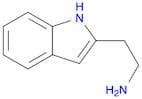
CAS 496-42-4
:1H-Indole-2-ethanamine
Description:
1H-Indole-2-ethanamine, also known as tryptamine, is an organic compound characterized by its indole structure, which consists of a fused benzene and pyrrole ring. This compound features an ethylamine side chain at the 2-position of the indole ring, contributing to its biological activity. Tryptamine is a colorless to pale yellow solid at room temperature and is soluble in water and organic solvents. It is known for its role as a neurotransmitter and is a precursor to various biologically significant compounds, including serotonin and melatonin. The compound exhibits a range of pharmacological properties, including potential psychoactive effects, and is studied for its influence on mood and cognition. Tryptamine can participate in various chemical reactions, such as alkylation and acylation, making it a valuable intermediate in organic synthesis. Its CAS number, 496-42-4, is used for identification in chemical databases and regulatory contexts. Overall, 1H-Indole-2-ethanamine is significant in both chemistry and biochemistry due to its structural features and biological relevance.
Formula:C10H12N2
InChI:InChI=1S/C10H12N2/c11-6-5-9-7-8-3-1-2-4-10(8)12-9/h1-4,7,12H,5-6,11H2
InChI key:InChIKey=WRAUXDQDRDJTKM-UHFFFAOYSA-N
SMILES:C(CN)C1=CC=2C(N1)=CC=CC2
Synonyms:- 1H-Indole-2-ethanamine
- 2-(1H-Indol-2-yl)ethan-1-amine
- 2-(1H-Indol-2-yl)ethanamine
- 2-(1H-benzimidazol-2-yl)ethanamine
- 2-(Indol-2-yl)ethanamine
- 2-(Indol-2-yl)ethylamine
- Indole, 2-(2-aminoethyl)-
- Indole-2-ethylamine
- 2-(2-Aminoethyl)indole
Sort by
Purity (%)
0
100
|
0
|
50
|
90
|
95
|
100
Found 3 products.
2-(1H-Indol-2-yl)ethanamine
CAS:Formula:C10H12N2Purity:95.0%Color and Shape:Liquid, No data available.Molecular weight:160.222-(1H-Indol-2-yl)-ethylamine
CAS:2-(1H-Indol-2-yl)-ethylamine is a drug that has clinical relevance in the treatment of infectious diseases. It has been shown to inhibit the growth of bacteria by binding to the 50S ribosomal subunit. It also binds to human plasma proteins and other biological samples, which may be due to its ability to induce apoptosis. 2-(1H-Indol-2-yl)-ethylamine has been shown to be effective against bacterial infections in humans, such as methicillin resistant Staphylococcus aureus (MRSA) and Clostridium perfringens, although is not active against acid-fast bacteria such as Mycobacterium tuberculosis or Mycobacterium avium complex. 2-(1H-Indol-2-yl)-ethylamine has been shown to have anti-inflammatory properties, which may be due to its inhibition of prostaglandin synthesis. The drug inhibits proteinFormula:C10H12N2Purity:Min. 95%Molecular weight:160.22 g/mol