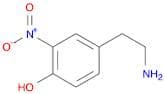
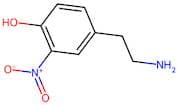
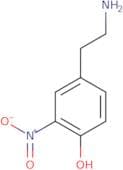
CAS 49607-15-0
:4-(2-aminoethyl)-2-nitrophenol
Description:
4-(2-aminoethyl)-2-nitrophenol, with the CAS number 49607-15-0, is an organic compound characterized by the presence of both an amino group and a nitro group attached to a phenolic structure. This compound typically appears as a solid and is soluble in polar solvents due to the presence of the hydroxyl and amino functional groups. The nitro group introduces significant electron-withdrawing characteristics, which can influence the compound's reactivity and stability. It may exhibit properties such as being a potential intermediate in organic synthesis or a reagent in various chemical reactions. The amino group can participate in hydrogen bonding, enhancing its solubility in water and other polar solvents. Additionally, the compound may have applications in dye chemistry or as a building block for pharmaceuticals, given its functional groups that can undergo further chemical transformations. Safety data should be consulted, as compounds with nitro groups can sometimes be hazardous, and appropriate handling procedures should be followed.
Formula:C8H10N2O3
InChI:InChI=1/C8H10N2O3/c9-4-3-6-1-2-8(11)7(5-6)10(12)13/h1-2,5,11H,3-4,9H2
SMILES:c1cc(c(cc1CCN)N(=O)=O)O
Synonyms:- 3-Nitrotyramine
- Phenol, 4-(2-Aminoethyl)-2-Nitro-
Sort by
Purity (%)
0
100
|
0
|
50
|
90
|
95
|
100
Found 4 products.
3-Nitrotyramine
CAS:<p>3-Nitrotyramine is a compound that has catabolic properties. It is the product of tyrosine, which is an amino acid found in most proteins. 3-Nitrotyramine has been shown to be metabolized by humans through the liver and kidneys. The metabolic pathway for this compound starts with the conversion of L-methionine into dl-methionine. This reaction generates a molecule called S-adenosyl methionine, or SAMe, which is involved in many biological processes such as neurotransmitter synthesis and gene expression regulation. 3-Nitrotyramine can also be converted into dopamine by way of the enzyme catecholamine methyltransferase. Dopamine has been shown to have a variety of effects on human physiology, including being involved in mood disorders and motor control. 3-Nitrotyramine can also be converted into gold nanoparticles by means of an acid analysis test.</p>Formula:C8H10N2O3Purity:Min. 95%Color and Shape:PowderMolecular weight:182.18 g/mol