CAS 497833-05-3
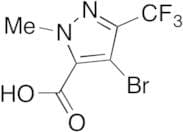
:1H-Pyrazole-5-carboxylic acid, 4-bromo-1-methyl-3-(trifluoromethyl)-
Description:
1H-Pyrazole-5-carboxylic acid, 4-bromo-1-methyl-3-(trifluoromethyl)- is a heterocyclic organic compound characterized by its pyrazole ring structure, which consists of five members with two adjacent nitrogen atoms. This compound features a carboxylic acid functional group, contributing to its acidity and potential reactivity in various chemical reactions. The presence of a bromine atom at the 4-position and a trifluoromethyl group at the 3-position enhances its electrophilic character and may influence its biological activity. The methyl group at the 1-position adds to the compound's steric properties. This compound is of interest in medicinal chemistry and material science due to its potential applications in drug development and as a building block for more complex molecules. Its unique combination of functional groups may impart specific pharmacological properties, making it a subject of research in various fields, including agrochemicals and pharmaceuticals. Proper handling and storage are essential due to the presence of halogenated groups, which can pose environmental and health risks.
Formula:C6H4BrF3N2O2
Sort by
Purity (%)
0
100
|
0
|
50
|
90
|
95
|
100
Found 3 products.
4-Bromo-2-methyl-5-trifluoromethyl-2 H -pyrazole-3-carboxylic acid
CAS:Formula:C6H4BrF3N2O2Purity:95.0%Color and Shape:SolidMolecular weight:273.0094-Bromo-1-methyl-3-(trifluoromethyl)-1H-pyrazole-5-carboxylic Acid
CAS:Controlled ProductApplications 4-Bromo-1-methyl-3-(trifluoromethyl)-1H-pyrazole-5-carboxylic Acid is a reactant in the synthesis of 1-methyl-3-(trifluoromethyl)-N-[4-sulfonylphenyl]-1H-pyrazole-5-carboxamide, a nonpeptidic measles virus inhibitor.
References Sun, A., et. al.: J. Med. Chem., 51, 3731 (2008)Formula:C6H4BrF3N2O2Color and Shape:NeatMolecular weight:273.014-Bromo-1-methyl-3-(trifluoromethyl)-1H-pyrazole-5-carboxylic acid
CAS:Versatile small molecule scaffoldFormula:C6H4BrF3N2O2Purity:Min. 95%Molecular weight:273.01 g/mol