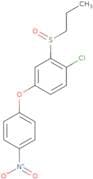
CAS 49828-75-3
:1-chloro-4-(4-nitrophenoxy)-2-(propylsulfinyl)benzene
Description:
1-Chloro-4-(4-nitrophenoxy)-2-(propylsulfinyl)benzene is an organic compound characterized by its complex structure, which includes a chloro group, a nitrophenoxy moiety, and a propylsulfinyl group attached to a benzene ring. This compound typically exhibits properties associated with aromatic compounds, such as stability and potential for electrophilic substitution reactions. The presence of the nitro group suggests that it may have electron-withdrawing properties, which can influence its reactivity and solubility in various solvents. The sulfinyl group introduces a sulfur atom, which can impart unique chemical behavior, including potential for oxidation and coordination with metal ions. This compound may be of interest in various fields, including pharmaceuticals and materials science, due to its potential biological activity and utility in synthetic applications. Its specific physical properties, such as melting point, boiling point, and solubility, would need to be determined experimentally or sourced from reliable chemical databases for practical applications.
Formula:C15H14ClNO4S
InChI:InChI=1/C15H14ClNO4S/c1-2-9-22(20)15-10-13(7-8-14(15)16)21-12-5-3-11(4-6-12)17(18)19/h3-8,10H,2,9H2,1H3
Sort by
Purity (%)
0
100
|
0
|
50
|
90
|
95
|
100
Found 1 products.
Phenproxide
CAS:Phenproxide is an analog of testosterone that has been used traditionally in Chinese medicine to treat tumors. It has been found to induce apoptosis in cancer cells by inhibiting kinases, which are enzymes that regulate cellular processes such as cell division and growth. Phenproxide has also been shown to inhibit the activity of somatostatin, a hormone that regulates the release of other hormones. This inhibition may contribute to its anti-cancer properties. In addition, Phenproxide has been shown to have an effect on hyaluronan metabolism, a substance involved in tissue repair and inflammation. It is excreted in urine and may be used as a potential biomarker for cancer diagnosis or monitoring.
Formula:C15H14ClNO4SPurity:Min. 95%Molecular weight:339.8 g/mol