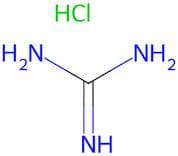
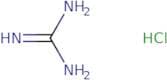
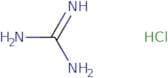
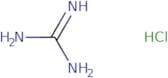
CAS 50-01-1
:Guanidine hydrochloride
- Buffer AL
- Chlorure de guanidinium
- Cloruro De Guanidinio
- Guanidin.Hcl
- Guanidine Hydrochloride
- Guanidine chloride
- Guanidine, hydrochloride (1:1)
- Guanidinium Chloride
- Guanidinium hydrochloride
- Guanidiniumchlorid
- Guanidine, monohydrochloride
- methanaminium, 1-amino-1-imino-, hydrochloride (1:1)
- Guanidine Hydrochlorie
- Guanidine HCl
- See more synonyms
Guanidine hydrochloride
CAS:Guanidine hydrochloridePurity:ultrapureColor and Shape:SolidMolecular weight:95.53g/molGuanidine Hydrochloride
CAS:Controlled ProductStability Hygroscpic
Applications Guanidine has a good bacterial and fungicidal efficacy when used in low concentration and can also be used as disinfectant.
References Laemmli, U., et al.: Nature, 227, 680 (1970), Nissen, N., et al.: Biochem. J., 338, 637 (1999), Gibson, C., et al.: Circulation, 101, 125 (2000),Formula:CH5N3·ClHColor and Shape:WhiteMolecular weight:95.53Guanidine Hydrochloride (GHC) extrapure for biochemistry, 99%
CAS:Formula:CH5N3·HClPurity:min. 99%Color and Shape:White, Crystalline compound, Clear, ColourlessMolecular weight:95.53Guanidine Hydrochloride (GHC) pure, 99%
CAS:Formula:CH5N3HClPurity:min. 99%Color and Shape:White, Crystalline powderMolecular weight:95.53Guanidine Hydrochloride (GHC) ExiPlus, Multi-Compendial, 99%
CAS:Formula:CH5N3·HClPurity:min. 99.5%Color and Shape:White, Crystalline compound, Clear, ColourlessMolecular weight:95.53Guanidine Hydrochloride (GHC) for molecular biology, 99.5%
CAS:Formula:CH5N3·HClPurity:min. 99.5%Color and Shape:White, Crystalline compound, Clear, ColourlessMolecular weight:95.53Guanidine hydrochloride
CAS:Guanidine hydrochloride is an important reagent in organic synthesis. It is a solid chemical that is soluble in water and other polar solvents. It is also used as a building block for the preparation of fine chemicals and pharmaceuticals. CAS No. 50-01-1Formula:CH6ClN3Purity:(%) Min. 99%Molecular weight:95.53 g/molGuanidine HCl - 60% solution in H2O
CAS:Guanidine HCl is a strong base that reacts with acids to form their salts. It is used in disinfectant solutions, where it binds to proteins and other organic matter, forming soluble complexes that can be easily removed. Guanidine HCl has been shown to have toxicological effects on the respiratory system of rats and mice. This is due to its ability to cause mucin gene expression in human lung cells, which leads to physiological effects such as mucous production. The reaction mechanism for guanidine HCl involves hydrogen bonding interactions with metal hydroxides.Formula:CH6ClN3Purity:Min. 95%Molecular weight:95.53 g/molGuanidine HCl
CAS:Guanidine is a guanidine salt that is used in the chemical industry as a raw material for the manufacture of plastics and synthetic rubber. It is also used as a disinfectant and deodorizer in wastewater treatment. The reaction mechanism of guanidine HCl involves hydrogen bonding interactions with the metal hydroxides and receptor activity. Guanidine has been shown to have an inhibitory effect on mucin gene expression, which may be due to its ability to inhibit toll-like receptor signalling pathways.
Formula:CH5N3·HClColor and Shape:White PowderMolecular weight:95.5 g/molRef: 3D-FG09296
Discontinued product