CAS 5001-18-3
:Adamantanediol
Description:
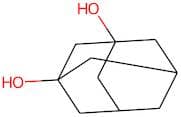
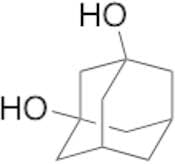
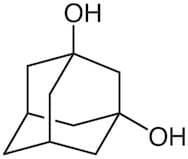
Adamantanediol, with the CAS number 5001-18-3, is a bicyclic organic compound derived from adamantane, characterized by the presence of two hydroxyl (-OH) groups. This compound exhibits a unique structure that contributes to its physical and chemical properties. Adamantanediol is typically a white crystalline solid at room temperature, and it is soluble in polar solvents such as water and alcohols, while being less soluble in non-polar solvents. The presence of hydroxyl groups allows for hydrogen bonding, which influences its melting and boiling points. Adamantanediol is known for its stability and resistance to oxidation, making it useful in various applications, including as a building block in organic synthesis and in the development of pharmaceuticals. Additionally, its structural features may impart interesting biological activities, although specific applications can vary. Overall, adamantanediol is a versatile compound with significant relevance in both industrial and research contexts.
Formula:C10H16O2
InChI:InChI=1/C10H16O2/c11-9-2-7-1-8(4-9)5-10(12,3-7)6-9/h7-8,11-12H,1-6H2
SMILES:C1C2CC3(CC1CC(C2)(C3)O)O
Synonyms:- 1,3-Adamantanediol
- 1,3-Dihydroxyadamantane
- Adamantane-1,3-DIOL
- Akos Bc-0470
- Tricyclo[3.3.1.13,7]decane-1,3-diol
- 1,3-Admantane-dimethanol
- 1,3-Adamantanedimethanol
- Tricyclo[3.3.1.1~3,7~]Decane-1,3-Diol
Sort by
Purity (%)
0
100
|
0
|
50
|
90
|
95
|
100
Found 9 products.
1,3-Adamantanediol
CAS:Formula:C10H16O2Purity:>98.0%(GC)Color and Shape:White to Almost white powder to crystalMolecular weight:168.24Tricyclo[3.3.1.13,7]decane-1,3-diol
CAS:Formula:C10H16O2Purity:97%Color and Shape:SolidMolecular weight:168.2328Adamantane-1,3-diol
CAS:<p>Adamantane-1,3-diol</p>Purity:97%Color and Shape:White SolidMolecular weight:168.23g/molAdamantane-1,3-diol
CAS:Formula:C10H16O2Color and Shape:White To Off-White SolidMolecular weight:168.241,3-Adamantanediol
CAS:Controlled Product<p>Applications 1,3-Adamantanediol is used in the synthesis of novel dimethacrylate as possible dental monomers for dental resin mixtures.<br>References Wang, K. et al.: Mat. Sci. Eng. Mat. Biol. Appl., 32, 1141 (2012); Horino, Y. et al.: J. Mol. Catal. A. Chem.,<br></p>Formula:C10H16O2Color and Shape:NeatMolecular weight:168.231,3-Dihydroxyadamantane
CAS:<p>1,3-Dihydroxyadamantane is a compound that belongs to the group of thermal expansion catalysts. It is an oxidation catalyst that reacts with hydrogen and trifluoroacetic acid to form 1-adamantanol, which is a molecule with a chemical structure consisting of one adamantane ring and one hydroxyl group. The reaction proceeds via a redox cycle: 1,3-dihydroxyadamantane is oxidized to 1,3-dhydroxymethyladamantane by hydrogen peroxide, then reduced back to 1,3-dihydroxyadamantane by sodium borohydride. Hydrochloric acid can be used as an alternative oxidizing agent in this reaction. The formation of n-oxide from 1,3-dihydroxyadamantane has been shown experimentally using titration calorimetry (TLC). This reaction mechanism proceeds through the following steps:</p>Formula:C10H16O2Purity:Min. 95%Color and Shape:PowderMolecular weight:168.23 g/mol

![Tricyclo[3.3.1.13,7]decane-1,3-diol](/_next/image/?url=https%3A%2Fstatic.cymitquimica.com%2Fproducts%2FIN%2Fthumb%2FDA00I8X8.jpg&w=3840&q=75)