CAS 500799-61-1
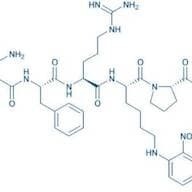
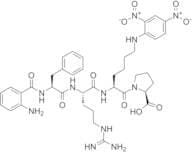
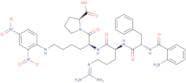
:Abz-Phe-Arg-Lys(Dnp)-Pro-Oh
Abz-Phe-Arg-Lys(Dnp)-Pro-OH
CAS:Excellent angiotensin I-converting enzyme (ACE) FRET substrate with a Km value of 4.0 µM and a kcat value of 210 s⁻¹. Alves et al. developed a continuous fluorescent assay using Abz-FRK(Dnp)P for the determination of ACE activity in plasma and tissue.Formula:C39H49N11O10Purity:> 98%Color and Shape:White PowderMolecular weight:831.89Abz-FR-K(Dnp)-P-OH
CAS:Excellent angiotensin I-converting enzyme (ACE) substrate with a Km value of 4.0 μM and a kcat value of 210s-1.Formula:C39H49N11O10Purity:98%Color and Shape:SolidMolecular weight:831.87Abz-frk(dnp)-P
CAS:Custom research peptide; min purity 95%. For different specs please use the Peptide Quote Tool
Formula:C39H49N11O10Molecular weight:831.4 g/molAbz-Phe-Arg-Lys(Dnp)-Pro-OH trifluoroacetate
CAS:Abz-Phe-Arg-Lys(Dnp)-Pro-OH trifluoroacetate (ABA) is a low potency activator of the endogenous angiotensin system, with no known clinical use. ABA has been shown to activate the endogenous angiotensin system in vivo in rats and humans. It has also been shown to increase blood pressure in rats by activating the renal sympathetic nervous system. The activation of this system may be due to its ability to release neutrophil chemotactic factor from adipose tissue, increasing the number of neutrophils that contribute to inflammation through their release of reactive oxygen species. The mechanism underlying this activation is unknown, but may involve an interaction with enalaprilat, a potent inhibitor of angiotensin converting enzyme (ACE), or adipose tissue lipolysis.
Formula:C39H49N11O10•(C2HF3O2)xPurity:Min. 95%Color and Shape:PowderMolecular weight:831.87 g/molRef: 3D-FA110981
Discontinued product