CAS 501938-01-8
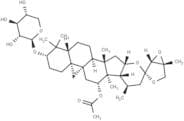
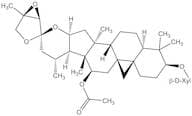
:(1'R,2S,4aR,5'R,5aR,7R,7aR,7bR,8R,10R,11aS,12aS,12bS,14aR)-1,1,5',7a,8,12a-hexamethyl-2-(beta-D-xylopyranosyloxy)hexadecahydro-2H-spiro[cyclopropa[1',8a']naphtho[2',1':4,5]indeno[2,1-b]pyran-10,2'-[3,6]dioxabicyclo[3.1.0]hexan]-7-yl acetate
Description:
The chemical substance with the name "(1'R,2S,4aR,5'R,5aR,7R,7aR,7bR,8R,10R,11aS,12aS,12bS,14aR)-1,1,5',7a,8,12a-hexamethyl-2-(beta-D-xylopyranosyloxy)hexadecahydro-2H-spiro[cyclopropa[1',8a']naphtho[2',1':4,5]indeno[2,1-b]pyran-10,2'-[3,6]dioxabicyclo[3.1.0]hexan]-7-yl acetate" and CAS number "501938-01-8" is a complex organic compound characterized by its intricate stereochemistry and multiple functional groups. It features a spirocyclic structure, which contributes to its unique three-dimensional conformation. The presence of a beta-D-xylopyranosyloxy group indicates that it is a glycoside, suggesting potential biological activity, possibly related to carbohydrate interactions. The hexamethyl substitution pattern implies a high degree of hydrophobicity, which may influence its solubility and interaction with biological membranes. Additionally, the acetate moiety suggests that it may undergo hydrolysis, releasing acetic acid and potentially altering its biological activity. Overall, this compound's structural complexity and functional groups position it as a candidate for further investigation in fields such as medicinal chemistry and natural product research.
Formula:C37H56O10
InChI:InChI=1/C37H56O10/c1-18-12-37(30-33(6,47-30)17-43-37)46-21-13-32(5)23-9-8-22-31(3,4)24(45-29-28(41)27(40)20(39)15-42-29)10-11-35(22)16-36(23,35)14-25(44-19(2)38)34(32,7)26(18)21/h18,20-30,39-41H,8-17H2,1-7H3/t18-,20-,21+,22+,23+,24+,25-,26+,27+,28-,29+,30-,32+,33-,34-,35-,36+,37-/m1/s1
Synonyms:- beta-D-xylopyranoside, (1'R,2S,4aR,5'R,5aR,7R,7aR,7bR,8R,10R,11aS,12aS,12bS,14aR)-7-(acetyloxy)hexadecahydro-1,1,5',7a,8,12a-hexamethylspiro[5H-cyclopropa[1',8'a]naphth[2',1':4,5]indeno[2,1-b]pyran-10(2H),2'-[3,6]dioxabicyclo[3.1.0]hexan]-2-yl
- (1'R,2S,4aR,5'R,5aR,7R,7aR,7bR,8R,10R,11aS,12aS,12bS,14aR)-1,1,5',7a,8,12a-Hexamethyl-2-(beta-D-xylopyranosyloxy)hexadecahydro-2H-spiro[cyclopropa[1',8a']naphtho[2',1':4,5]indeno[2,1-b]pyran-10,2'-[3,6]dioxabicyclo[3.1.0]hexan]-7-yl acetate
- DEOXYACTEIN, 27-(23-EPI-26-DEOXYACTEIN)(RG)
- β-D-Xylopyranoside, (3β,12β,16β,23R,24R,25R)-12-(acetyloxy)-16,23:23,26:24,25-triepoxy-9,19-cyclolanostan-3-yl
Sort by
Purity (%)
0
100
|
0
|
50
|
90
|
95
|
100
Found 4 products.
23-EPI-26-Deoxyactein
CAS:Other glycosides, natural or reproduced by synthesis, and their salts, ethers, esters and other derivativesFormula:C37H56O10Color and Shape:White PowderMolecular weight:660.3873523-epi-26-Deoxyactein
CAS:23-epi-26-Deoxyactein is a naturally occurring compound exhibiting anti-obesity and anti-cancer properties when administered orally [1] [2] [3].Formula:C37H56O10Color and Shape:SolidMolecular weight:660.8323-epi-26-deoxyactein
CAS:Natural glycosideFormula:C37H56O10Purity:≥ 90.0 % (HPLC)Color and Shape:PowderMolecular weight:660.8523-Epi-26-deoxyactein
CAS:23-Epi-26-deoxyactein is a triterpene glycoside, which is derived from the roots of the plant *Actaea racemosa*, commonly known as black cohosh. As a phytochemical, it belongs to a group of compounds known as saponins, which are characterized by their glycosidic linkages and steroidal or triterpenoid aglycones.
Formula:C37H56O10Purity:Min. 95%Molecular weight:660.8 g/molRef: 3D-BVA93801
Discontinued product