CAS 502-22-7
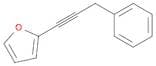
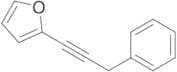
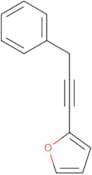
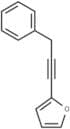
:2-(3-Phenyl-1-propyn-1-yl)furan
Description:
2-(3-Phenyl-1-propyn-1-yl)furan, with the CAS number 502-22-7, is an organic compound characterized by its furan ring structure substituted with a propyne group and a phenyl group. This compound features a furan moiety, which is a five-membered aromatic ring containing one oxygen atom, contributing to its potential reactivity and stability. The presence of the phenyl group enhances its aromatic characteristics, while the propyne substituent introduces a triple bond, which can participate in various chemical reactions, such as addition or substitution. The compound is typically a colorless to pale yellow liquid or solid, depending on its purity and specific conditions. It may exhibit interesting properties such as fluorescence or photochemical reactivity due to its conjugated system. Additionally, its unique structure may impart specific biological activities, making it of interest in medicinal chemistry and materials science. As with many organic compounds, handling should be done with care, considering potential toxicity and environmental impact.
Formula:C13H10O
InChI:InChI=1S/C13H10O/c1-2-6-12(7-3-1)8-4-9-13-10-5-11-14-13/h1-3,5-7,10-11H,8H2
InChI key:InChIKey=ICRHFCVRNWSKQH-UHFFFAOYSA-N
SMILES:C(#CCC1=CC=CC=C1)C2=CC=CO2
Synonyms:- 2-(3-Phenyl-1-propyn-1-yl)furan
- Carlina oxide
- Furan, 2-(3-phenyl-1-propyn-1-yl)-
- Furan, 2-(3-phenyl-1-propynyl)-
Sort by
Purity (%)
0
100
|
0
|
50
|
90
|
95
|
100
Found 4 products.
2-(3-phenylprop-1-ynyl)furan
CAS:Formula:C13H10OPurity:95%+Color and Shape:LiquidMolecular weight:182.2179Carlina Oxide
CAS:Controlled ProductApplications Carlina oxide is a natural polyacetylene from Carlina acaulis (Asteraceae). It showed antimicrobial, anti-inflammatory, anti-ulcer and antioxidant activities in rats.
References Herrmann, F., et al.: Planta Medica, 77, 1905 (2011); Dordevic, S., et al.: J. Ethnopharmacol., 109, 458 (2007)Formula:C13H10OColor and Shape:NeatMolecular weight:182.218Carlina oxide
CAS:Carlina oxide is a natural antibacterial compound that has been shown to inhibit the growth of C. glabrata and other bacteria. It is an antioxidant compound with strong antioxidative activity, which has been demonstrated by its ability to protect cells from damage induced by hydrogen peroxide. Carlina oxide also shows potent cytotoxicity against human cancer cells and has been shown to be effective in animal models for the treatment of infections caused by E. coli and F. faecalis strains. This compound has not yet been synthesized but can be extracted from the leaves of carline thistle (Carlina vulgaris).Formula:C13H10OPurity:Min. 95%Molecular weight:182.22 g/molCarlina oxide
CAS:Carlina oxide is both an AChE inhibitor and an antioxidant, effective in eliminating mosquito larvae (LC50=1.39 μg/mL). Furthermore, Carlina oxide exhibits cytotoxicity in vertebrate cells, human dermis, and HCT116 and MDA-MB231 cell lines.Formula:C13H10OColor and Shape:SolidMolecular weight:182.22