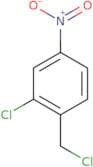
CAS 50274-95-8
:2-Chloro-1-(chloromethyl)-4-nitrobenzene
Description:
2-Chloro-1-(chloromethyl)-4-nitrobenzene, with the CAS number 50274-95-8, is an organic compound characterized by its aromatic structure, which includes a nitro group and two chlorine substituents. This compound typically appears as a yellow to brown solid and is known for its moderate solubility in organic solvents. The presence of the nitro group contributes to its electron-withdrawing properties, influencing its reactivity and making it a potential intermediate in various chemical syntheses. It is often used in the production of dyes, pharmaceuticals, and agrochemicals. Due to the presence of chlorine atoms, it may exhibit toxicity and environmental persistence, necessitating careful handling and disposal. Additionally, its chemical properties allow for electrophilic substitution reactions, making it a valuable compound in synthetic organic chemistry. Safety precautions should be observed when working with this substance, as it may pose health risks through inhalation or skin contact.
Formula:C7H5Cl2NO2
InChI:InChI=1S/C7H5Cl2NO2/c8-4-5-1-2-6(10(11)12)3-7(5)9/h1-3H,4H2
InChI key:InChIKey=OFZJESMXFWZEAW-UHFFFAOYSA-N
SMILES:N(=O)(=O)C1=CC(Cl)=C(CCl)C=C1
Synonyms:- 2-Chloro-1-(Chloromethyl)-4-Nitrobenzene
- 2-Chloro-4-nitrobenzyl chloride
- Benzene, 2-chloro-1-(chloromethyl)-4-nitro-
- Toluene, α,2-dichloro-4-nitro-
- alpha,2-Dichloro-4-nitrotoluene
Sort by
Purity (%)
0
100
|
0
|
50
|
90
|
95
|
100
Found 1 products.
2-Chloro-1-(chloromethyl)-4-nitrobenzene
CAS:2-Chloro-1-(chloromethyl)-4-nitrobenzene is a silver salt used in the manufacture of photographic emulsions. It is prepared by reacting 2-chloro-3-nitropyridine with silver nitrate. The reaction produces a white precipitate that can be recrystallized from water or ethanol. This compound has been shown to be an effective antimicrobial agent against bacteria and fungi, and can be used to prevent the growth of mould on photographic film.Formula:C7H5Cl2NO2Purity:Min. 95%Molecular weight:206.02 g/mol