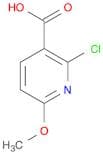
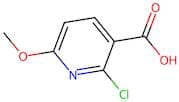
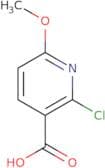
CAS 503000-87-1
:2-chloro-6-methoxypyridine-3-carboxylic acid
Description:
2-Chloro-6-methoxypyridine-3-carboxylic acid is a heterocyclic organic compound characterized by its pyridine ring structure, which includes a chlorine atom and a methoxy group as substituents. The presence of the carboxylic acid functional group contributes to its acidic properties, making it soluble in polar solvents. This compound typically exhibits moderate stability under standard conditions but may be sensitive to strong bases or oxidizing agents. Its molecular structure allows for potential interactions in biological systems, which may be of interest in pharmaceutical applications. The chlorine atom can influence the compound's reactivity and biological activity, while the methoxy group may enhance lipophilicity. Overall, 2-chloro-6-methoxypyridine-3-carboxylic acid is a versatile compound with potential applications in medicinal chemistry, agrochemicals, and material science, owing to its unique functional groups and structural characteristics.
Formula:C7H6ClNO3
InChI:InChI=1/C7H6ClNO3/c1-12-5-3-2-4(7(10)11)6(8)9-5/h2-3H,1H3,(H,10,11)
SMILES:COc1ccc(c(Cl)n1)C(=O)O
Synonyms:- 2-Chloro-6-methoxynicotinic acid
- 3-Pyridinecarboxylic Acid, 2-Chloro-6-Methoxy-
Sort by
Purity (%)
0
100
|
0
|
50
|
90
|
95
|
100
Found 4 products.
2-Chloro-6-methoxynicotinic acid
CAS:Formula:C7H6ClNO3Purity:98%Color and Shape:SolidMolecular weight:187.58042-Chloro-6-methoxynicotinic acid
CAS:2-Chloro-6-methoxynicotinic acidFormula:C7H6ClNO3Purity:≥95%Color and Shape: solidMolecular weight:187.58g/mol2-Chloro-6-methoxynicotinic acid
CAS:Formula:C7H6ClNO3Purity:95%Color and Shape:SolidMolecular weight:187.582-Chloro-6-methoxynicotinic acid
CAS:2-Chloro-6-methoxynicotinic acid is a halogenated organic compound that has the molecular formula CHClNO. It is a colorless solid. 2-Chloro-6-methoxynicotinic acid is an intermediate in the industrial production of other chemicals and pharmaceuticals. This compound reacts with nucleophiles such as chlorine, hydrochloric acid, and sodium hydroxide to form chlorides, which are important intermediates in chemical reactions. 2-Chloro-6-methoxynicotinic acid can be converted to a variety of different compounds by reacting it with other reagents or by using specific catalysts. For example, it can react with chlorine gas to produce trichloromethylating agents such as dichloromethyl ether and chloral hydrate.Formula:C7H6ClNO3Purity:Min. 95%Molecular weight:187.58 g/mol