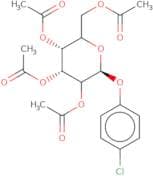
CAS 5041-92-9
:N'-acetyl-4-chlorobenzohydrazide
Description:
N'-Acetyl-4-chlorobenzohydrazide, with the CAS number 5041-92-9, is an organic compound characterized by its hydrazide functional group and an acetyl substituent. It typically appears as a crystalline solid and is soluble in organic solvents such as ethanol and dimethyl sulfoxide, but may have limited solubility in water. The presence of the 4-chloro substituent on the benzene ring enhances its reactivity, making it useful in various chemical reactions, including those involving hydrazones and azo compounds. This compound is often utilized in pharmaceutical research and synthesis due to its potential biological activity, including antimicrobial and anti-inflammatory properties. Its structure allows for the formation of derivatives that can be explored for various applications in medicinal chemistry. As with many hydrazides, it may exhibit sensitivity to moisture and should be handled with care in a controlled laboratory environment to ensure safety and stability.
Formula:C20H23ClO10
InChI:InChI=1/C9H9ClN2O2/c1-6(13)11-12-9(14)7-2-4-8(10)5-3-7/h2-5H,1H3,(H,11,13)(H,12,14)
SMILES:CC(=NNC(=O)c1ccc(cc1)Cl)O
Synonyms:- Benzoic Acid, 4-Chloro-, 2-Acetylhydrazide
- β-D-Glucopyranoside, 4-chlorophenyl, 2,3,4,6-tetraacetate
- (2R,3R,4S,5R,6S)-2-(acetoxymethyl)-6-(4-chlorophenoxy)tetrahydro-2H-pyran-3,4,5-triyl triacetate
- 4''-CHLOROPHENYL-2,3,4,6-TETRA-O-ACETYL-SS-D-GLUCOPYRANOSIDE
- 4-Chlorophenyl-2,3,4,6-tetra-O-acetyl-b-D-glucopyranoside
- 4'-CHLOROPHENYL-2,3,4,6-TETRA-O-ACETYL-BETA-D-GLUCOPYRANOSIDE
Sort by
Purity (%)
0
100
|
0
|
50
|
90
|
95
|
100
Found 1 products.
4-Chlorophenyl-2,3,4,6-tetra-O-acetyl-b-D-glucopyranoside
CAS:4-Chlorophenyl-2,3,4,6-tetra-O-acetyl-b-D-glucopyranoside is a custom synthesis of an Oligosaccharide. It is a synthetic compound that contains a sugar that is attached to a 4 chlorophenol. The glycosylation process has been completed with the addition of an acetate group. This product is fluorinated at the 2 and 4 positions with chlorine gas and methylated at the 6 position. The modification process has been completed with click chemistry, which involves the reaction of an azide and an alkyne to form a 1,3 dipole. The complex carbohydrate has been modified by adding a saccharide group to the Carbonyl group on the right side of the molecule.Formula:C20H23ClO10Purity:Min. 95%Molecular weight:458.9 g/mol