CAS 5042-53-5
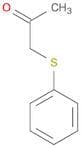
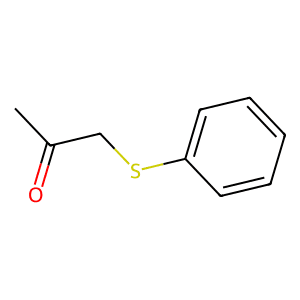
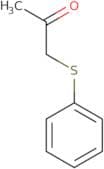
:1-(phenylsulfanyl)propan-2-one
Description:
1-(Phenylsulfanyl)propan-2-one, also known as phenyl thioacetone, is an organic compound characterized by the presence of a thioether functional group and a ketone. It features a propan-2-one backbone with a phenylsulfanyl substituent at the first carbon. This compound typically appears as a colorless to pale yellow liquid with a distinct odor. It is soluble in organic solvents such as ethanol and ether but has limited solubility in water due to its hydrophobic nature. The presence of the thioether group imparts unique reactivity, making it useful in various organic synthesis applications, including the formation of thioethers and other sulfur-containing compounds. Additionally, it may exhibit biological activity, which has been the subject of research in medicinal chemistry. Safety precautions should be taken when handling this compound, as it may pose health risks if inhaled or ingested. Overall, 1-(phenylsulfanyl)propan-2-one is a valuable compound in both industrial and research settings.
Formula:C9H10OS
InChI:InChI=1/C9H10OS/c1-8(10)7-11-9-5-3-2-4-6-9/h2-6H,7H2,1H3
SMILES:CC(=O)CSc1ccccc1
Synonyms:- 1-(Phenylsulfanyl)acetone
- 2-Propanone, 1-(phenylthio)-
- 3-Phenylthiopropan-2-One
Sort by
Purity (%)
0
100
|
0
|
50
|
90
|
95
|
100
Found 4 products.
1-(Phenylthio)propan-2-one
CAS:Formula:C9H10OSPurity:95%Color and Shape:SolidMolecular weight:166.24011-(Phenylthio)propan-2-one
CAS:1-(Phenylthio)propan-2-oneFormula:C9H10OSPurity:97%Color and Shape: white crystalline solidMolecular weight:166.24g/mol(Phenylthio)propanone
CAS:Phenylthiopropanone (PTPA) is an organic compound that belongs to the class of sulfoxides. It can be synthesized from ethyl ester, chloroform, and phenylthiol in a three-step process using methodologies such as biotransformations or chemoenzymatic reactions. PTPA can also be obtained by reacting sodium sulfoxide with phosphorus pentachloride. PTPA has been used as a precursor for other compounds including the hydroxy group, chloride, and synthetically desulfurized phenylthioacetaldehyde. The synthesis of PTPA is usually carried out in the presence of a catalyst and kinetic control of the reaction is necessary to avoid undesired side reactions.
Formula:C9H10OSPurity:Min. 95%Molecular weight:166.24 g/mol