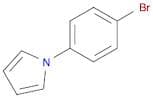
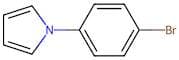
CAS 5044-39-3
:1-(4-bromophenyl)-1H-pyrrole
Description:
1-(4-Bromophenyl)-1H-pyrrole, with the CAS number 5044-39-3, is an organic compound characterized by its pyrrole ring, which is a five-membered aromatic heterocycle containing one nitrogen atom. The presence of a bromophenyl group at the 1-position of the pyrrole ring introduces significant electronic and steric effects, influencing its reactivity and properties. This compound typically exhibits a pale yellow to brownish color and is soluble in organic solvents such as dichloromethane and ethanol, but may have limited solubility in water due to its hydrophobic characteristics. It is often used in organic synthesis and can serve as an intermediate in the production of various pharmaceuticals and agrochemicals. The bromine substituent can participate in electrophilic aromatic substitution reactions, making it a versatile building block in synthetic chemistry. Additionally, the compound may exhibit interesting biological activities, which can be explored in medicinal chemistry contexts. Safety precautions should be taken when handling this compound, as it may pose health risks due to the presence of bromine.
Formula:C10H8BrN
InChI:InChI=1/C10H8BrN/c11-9-3-5-10(6-4-9)12-7-1-2-8-12/h1-8H
SMILES:c1ccn(c1)c1ccc(cc1)Br
Synonyms:- 1-(4-Bromo-phenyl)-1H-pyrrole
- 1H-pyrrole, 1-(4-bromophenyl)-
- T5Nj Ar De [Wln]
Sort by
Purity (%)
0
100
|
0
|
50
|
90
|
95
|
100
Found 4 products.
1-(4-Bromo-phenyl)-1H-pyrrole
CAS:Formula:C10H8BrNPurity:98%Color and Shape:SolidMolecular weight:222.08121-(4-Bromophenyl)pyrrole
CAS:<p>1-(4-Bromophenyl)pyrrole is a primary amine that can be synthesized by cross-coupling of 1,2-dibromobenzene and pyrrole. This process involves the use of palladium as a catalyst to promote the reaction. The catalytic activity of the palladium is increased by hydrogen sulfate and chlorine, which act as promoters in this reaction. The synthesis of 1-(4-bromophenyl)pyrrole can also be accomplished by reacting with primary amines in tetrahydrofuran at high temperatures. Reaction conditions are also dependent on the presence or absence of fluorine gas, which may cause an increase in the yield and decrease in reaction time. In addition, irradiation can be used to break down pyrrole into its constituent parts for use in synthesizing 1-(4-bromophenyl)pyrrole.</p>Formula:C10H8BrNPurity:Min. 95%Molecular weight:222.08 g/mol