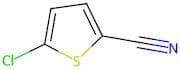
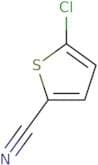
CAS 50478-16-5
:5-chlorothiophene-2-carbonitrile
Description:
5-Chlorothiophene-2-carbonitrile is an organic compound characterized by its thiophene ring structure, which is a five-membered aromatic heterocycle containing sulfur. The presence of a chlorine atom at the 5-position and a cyano group (-C≡N) at the 2-position contributes to its unique chemical properties. This compound is typically a colorless to pale yellow solid and is known for its potential applications in pharmaceuticals, agrochemicals, and materials science due to its reactivity and ability to participate in various chemical reactions, such as nucleophilic substitutions and cycloadditions. Its molecular structure allows for interactions that can lead to the formation of diverse derivatives, making it a valuable intermediate in synthetic chemistry. Additionally, the presence of the cyano group enhances its polarity and solubility in polar solvents, which can influence its behavior in biological systems and chemical reactions. Safety data should be consulted for handling and storage, as with many halogenated and nitrile compounds, it may pose health and environmental risks.
Formula:C5H2ClNS
InChI:InChI=1/C5H2ClNS/c6-5-2-1-4(3-7)8-5/h1-2H
SMILES:c1cc(Cl)sc1C#N
Sort by
Purity (%)
0
100
|
0
|
50
|
90
|
95
|
100
Found 3 products.
5-Chlorothiophene-2-carbonitrile
CAS:5-Chlorothiophene-2-carbonitrilePurity:98%Molecular weight:143.59g/mol5-chlorothiophene-2-carbonitrile
CAS:<p>5-Chlorothiophene-2-carbonitrile is a reactive heterocyclic compound that can be made by the chlorination of thiophene. It can be used as a precursor to other compounds, such as 1,3-dipolar cycloaddition products and 1,3-dioxolanes. 5-Chlorothiophene-2-carbonitrile has been shown to react with isoxazoles in a 1,3-dipolar cycloaddition reaction. This reaction produces dimers that are useful intermediates for the synthesis of pharmaceuticals. 5-Chlorothiophene-2-carbonitrile can also be used in an enantiospecific synthesis of 2,4,5,6 tetrahydropyrimidines. Irradiation of 5 chlorothiophene 2 carbonitrile leads to the formation of the corresponding n oxide or chloride and aldehyde.</p>Formula:C5H2ClNSPurity:Min. 95%Molecular weight:143.6 g/mol