CAS 50602-38-5
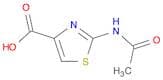
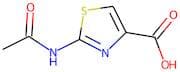
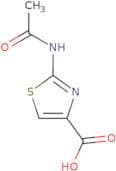
:2-(acetylamino)-1,3-thiazole-4-carboxylic acid
Description:
2-(Acetylamino)-1,3-thiazole-4-carboxylic acid, with the CAS number 50602-38-5, is a heterocyclic organic compound characterized by the presence of a thiazole ring, an acetylamino group, and a carboxylic acid functional group. This compound typically exhibits properties such as being a solid at room temperature, with potential solubility in polar solvents due to the presence of the carboxylic acid group. The thiazole ring contributes to its aromatic character and may influence its reactivity and interaction with biological systems. The acetylamino group can enhance its ability to participate in various chemical reactions, including acylation and amidation. This compound may have applications in pharmaceuticals or biochemistry, particularly in the development of drugs or as a biochemical probe, owing to its structural features that can interact with biological targets. Its stability and reactivity can be influenced by pH and the presence of other functional groups in a reaction environment.
Formula:C6H6N2O3S
InChI:InChI=1/C6H6N2O3S/c1-3(9)7-6-8-4(2-12-6)5(10)11/h2H,1H3,(H,10,11)(H,7,8,9)
SMILES:CC(=Nc1nc(cs1)C(=O)O)O
Synonyms:- 2-Acetamido-1,3-thiazole-4-carboxylic acid
- 4-Thiazolecarboxylic acid, 2-(acetylamino)-
Sort by
Purity (%)
0
100
|
0
|
50
|
90
|
95
|
100
Found 3 products.
2-Acetamidothiazole-4-carboxylic acid
CAS:Formula:C6H6N2O3SPurity:95%Color and Shape:SolidMolecular weight:186.18842-Acetamido-1,3-thiazole-4-carboxylic acid
CAS:2-Acetamido-1,3-thiazole-4-carboxylic acidPurity:≥95%Color and Shape:PowderMolecular weight:186.19g/mol2-Acetylamino-thiazole-4-carboxylic acid
CAS:2-Acetylamino-thiazole-4-carboxylic acid is a sulphoxide metabolite of 2-acetylamino-4,5,6,7-tetrahydrothiazolo[4,5,-c]pyridine. It is metabolized to mercapturic acid and sulphone by the enzyme cytochrome P450. This metabolite is also found in urine as a result of its metabolism by the enzyme N-acetyltransferase.Formula:C6H6N2O3SPurity:Min. 95%Molecular weight:186.19 g/mol