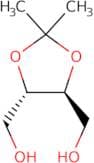
CAS 50622-09-8
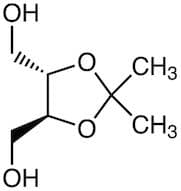
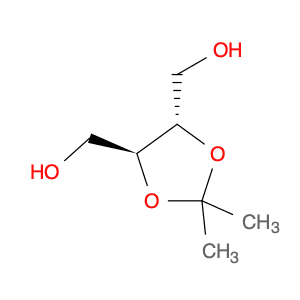
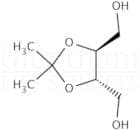
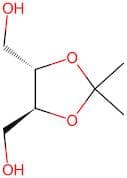
:(4S,5S)-2,2-Dimethyl-1,3-dioxolane-4,5-dimethanol
Description:
(4S,5S)-2,2-Dimethyl-1,3-dioxolane-4,5-dimethanol is a chemical compound characterized by its unique dioxolane ring structure, which features two hydroxymethyl groups at the 4 and 5 positions and two methyl groups at the 2 position. This compound is a chiral molecule, with specific stereochemistry denoted by the (4S,5S) configuration, indicating the spatial arrangement of its atoms. The presence of the dioxolane ring contributes to its stability and reactivity, making it a potential candidate for various chemical reactions, including those in organic synthesis. The hydroxymethyl groups enhance its solubility in polar solvents and may participate in hydrogen bonding, influencing its physical properties such as boiling point and melting point. Additionally, the compound's structure suggests potential applications in pharmaceuticals or as intermediates in organic synthesis due to the functional groups present. Overall, (4S,5S)-2,2-Dimethyl-1,3-dioxolane-4,5-dimethanol is notable for its stereochemistry and functional versatility in chemical reactions.
Formula:C7H14O4
InChI:InChI=1S/C7H14O4/c1-7(2)10-5(3-8)6(4-9)11-7/h5-6,8-9H,3-4H2,1-2H3/t5-,6-/m0/s1
InChI key:InChIKey=INVRLGIKFANLFP-WDSKDSINSA-N
SMILES:C(O)[C@H]1[C@H](CO)OC(C)(C)O1
Synonyms:- (+)-2,3-O-Isopropylidene-<span class="text-smallcaps">L</span>-threitol
- (+)-2,3-O-Isopropylidene-L-Threitol
- (2,2-Dimethyl-1,3-dioxolane-4,5-diyl)dimethanol
- (4S,5S)-2,2-Dimethyl-1,3-dioxolane-4,5-dimethanol
- (4S,5S)-4,5-Bis(hydroxymethyl)-2,2-dimethyl-1,3-dioxolane
- 1,3-Dioxolane-4,5-Dimethanol, 2,2-Dimethyl-
- 1,3-Dioxolane-4,5-dimethanol, 2,2-dimethyl-, (4S,5S)-
- 1,3-Dioxolane-4,5-dimethanol, 2,2-dimethyl-, (4S-trans)-
- 256-658-6
- [(4S,5S)-2,2-dimethyl-1,3-dioxolane-4,5-diyl]dimethanol
Sort by
Purity (%)
0
100
|
0
|
50
|
90
|
95
|
100
Found 8 products.
(+)-2,3-O-Isopropylidene-L-threitol
CAS:Formula:C7H14O4Purity:>97.0%(GC)Color and Shape:White or Colorless to Light yellow powder to lump to clear liquidMolecular weight:162.191,3-Dioxolane-4,5-dimethanol, 2,2-dimethyl-, (4S,5S)-
CAS:Formula:C7H14O4Purity:98%Color and Shape:SolidMolecular weight:162.18372,3-O-Isoproylidene-L-threitol
CAS:Formula:C7H14O4Purity:(GC) ≥ 97.0%Color and Shape:Conflicting attributes definedMolecular weight:162.19(+)-2,3-O-Isopropylidene-L-threitol
CAS:(+)-2,3-O-Isopropylidene-L-threitolPurity:99%Molecular weight:162.18g/mol2,3-O-Isopropylidene-L-threitol
CAS:Controlled ProductApplications 2,3-O-Isopropylidene-L-threitol is an intermediate in the synthesis of versicolactone compounds.
References Wang, L., et al.: Tetrahedron. Lett., 54, 6729 (2013);Formula:C7H14O4Color and Shape:NeatMolecular weight:162.18((4S,5S)-2,2-Dimethyl-1,3-dioxolane-4,5-diyl)dimethanol
CAS:Formula:C7H14O4Purity:99%+(GC-MS);RGColor and Shape:No data available.Molecular weight:162.1852,3-O-Isopropylidene-L-threitol
CAS:2,3-O-Isopropylidene-L-threitol is a chiral sugar alcohol that is a new type of HDAC inhibitor. It has been shown to be an effective inhibitor of histone deacetylase (HDAC) and can be used in the treatment of certain cancers. 2,3-O-Isopropylidene-L-threitol is considered to be enantiomerically pure because it contains only one stereoisomer. It is also synthesized via a dehydrogenative process, which starts with the addition of 2 equivalents of phenol to diphenol followed by the addition of 4 equivalents of biphenyl. This product can also be used to make polycarbonates with functional groups such as epoxy or vinyl groups.Formula:C7H14O4Purity:Min. 95%Color and Shape:Yellow PowderMolecular weight:162.18 g/mol