CAS 50638-46-5
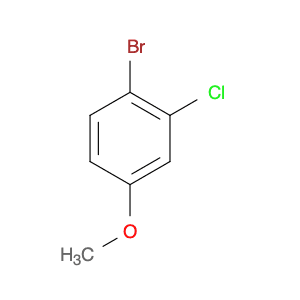
:1-Bromo-2-chloro-4-methoxybenzene
Description:
1-Bromo-2-chloro-4-methoxybenzene, with the CAS number 50638-46-5, is an aromatic compound characterized by the presence of both bromine and chlorine substituents on a benzene ring, along with a methoxy group (-OCH3) at the para position. This compound typically appears as a colorless to pale yellow liquid or solid, depending on its purity and temperature. It is known for its moderate polarity due to the electronegative halogen atoms and the methoxy group, which can influence its reactivity and solubility in various solvents. The presence of the bromine and chlorine atoms makes it a potential candidate for nucleophilic substitution reactions, while the methoxy group can act as an electron-donating group, enhancing the reactivity of the aromatic ring. Additionally, this compound may exhibit biological activity, making it of interest in medicinal chemistry and material science. Proper handling and storage are essential due to its potential toxicity and environmental impact.
Formula:C7H6BrClO
InChI:InChI=1S/C7H6BrClO/c1-10-5-2-3-6(8)7(9)4-5/h2-4H,1H3
InChI key:InChIKey=SUFFQYRWSRMBQC-UHFFFAOYSA-N
SMILES:O(C)C1=CC(Cl)=C(Br)C=C1
Synonyms:- 1-Bromo-2-chloro-4-(methyloxy)benzene
- 1-Bromo-2-chloro-4-methoxybenzene
- 3-Chloro-4-bromoanisole
- 4-Bromo-3-chlorophenyl methyl ether
- Benzene, 1-bromo-2-chloro-4-methoxy-
- 4-Bromo-3-chloroanisole
Sort by
Purity (%)
0
100
|
0
|
50
|
90
|
95
|
100
Found 4 products.
1-Bromo-2-chloro-4-methoxybenzene
CAS:Formula:C7H6BrClOPurity:97%Color and Shape:LiquidMolecular weight:221.47894-Bromo-3-chloroanisole
CAS:4-Bromo-3-chloroanisoleFormula:C7H6BrClOPurity:98%Color and Shape: clear. colourless liquidMolecular weight:221.48g/mol1-Bromo-2-chloro-4-methoxybenzene
CAS:1-Bromo-2-chloro-4-methoxybenzene is a polychlorinated bromoarene. It is used as a precursor to produce the hydroxamic acid, 1-bromo-2,4-dichlorobenzene. This compound has been shown to be a powerful inhibitor of bacterial growth in activated sludge and soil bacteria. It also inhibits plant growth and has been used as an herbicide. The synthesis of this compound starts with acetonitrile and phenol, which are heated together to produce the desired product in high yields. The solvents are then removed by vacuum distillation or crystallization.
Formula:C7H6BrClOPurity:Min. 95%Molecular weight:221.48 g/mol