CAS 50700-61-3
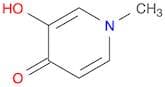
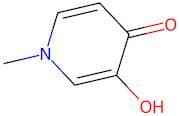
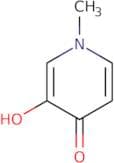
:3-hydroxy-1-methylpyridin-4(1H)-one
Description:
3-Hydroxy-1-methylpyridin-4(1H)-one, also known by its CAS number 50700-61-3, is a heterocyclic organic compound characterized by a pyridine ring with a hydroxyl group and a methyl group attached. This compound typically exhibits a pale yellow to light brown appearance and is soluble in polar solvents such as water and alcohols, owing to the presence of the hydroxyl group. It is known for its potential biological activities, including antioxidant properties and possible applications in pharmaceuticals and agrochemicals. The compound's structure allows for hydrogen bonding, which can influence its reactivity and interactions with other molecules. Additionally, it may participate in various chemical reactions, such as oxidation or complexation with metal ions, making it of interest in coordination chemistry. Overall, 3-hydroxy-1-methylpyridin-4(1H)-one is a versatile compound with significant implications in both research and industrial applications.
Formula:C6H7NO2
InChI:InChI=1/C6H7NO2/c1-7-3-2-5(8)6(9)4-7/h2-4,9H,1H3
SMILES:Cn1ccc(=O)c(c1)O
Synonyms:- 3-Hydroxy-1-methyl-4(1H)-pyridinone
- 4(1H)-pyridinone, 3-hydroxy-1-methyl-
Sort by
Purity (%)
0
100
|
0
|
50
|
90
|
95
|
100
Found 4 products.
3-hydroxy-1-methyl-4(1H)-Pyridinone
CAS:Formula:C6H7NO2Purity:97%Color and Shape:SolidMolecular weight:125.12533-Hydroxy-1-methylpyridin-4(1H)-one
CAS:Formula:C6H7NO2Purity:97%Color and Shape:SolidMolecular weight:125.1273-Hydroxy-1-methylpyridin-4(1H)-one
CAS:3-Hydroxypyridin-4(1H)-one is a compound that belongs to the group of organic compounds called pyridines. It is a colorless, crystalline solid with a melting point of 210 °C. 3-Hydroxypyridin-4(1H)-one is soluble in ether and chloroform. 3-Hydroxypyridin-4(1H)-one forms complexes with metal ions such as copper, zinc, and nickel. The stability constants for these complexes are in the order of Cu > Zn > Ni. Potentiometric titration experiments show that the ligands are stronger bases than water and therefore react more strongly with copper ions than hydroxide ions.Formula:C6H7NO2Purity:Min. 95%Color and Shape:PowderMolecular weight:125.13 g/mol