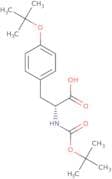
CAS 507276-74-6
:Boc-D-Tyr(tBu)-OH
Description:
Boc-D-Tyr(tBu)-OH, also known as Boc-D-Tyrosine(t-butyl), is a protected form of the amino acid tyrosine, which is commonly used in peptide synthesis and organic chemistry. The "Boc" (tert-butyloxycarbonyl) group serves as a protective group for the amino functionality, allowing for selective reactions without interference from the amine. The "D" indicates that the tyrosine is in its D-enantiomeric form, which is important in studies involving stereochemistry and biological activity. The "tBu" (tert-butyl) group attached to the phenolic hydroxyl of tyrosine enhances the compound's lipophilicity and stability, making it useful in various synthetic applications. This compound is typically a white to off-white solid and is soluble in organic solvents, such as dichloromethane and dimethyl sulfoxide, but less soluble in water. Its applications extend to the synthesis of peptides and other bioactive molecules, where the protection of functional groups is crucial for achieving desired reactivity and selectivity in chemical transformations.
Sort by
Purity (%)
0
100
|
0
|
50
|
90
|
95
|
100
Found 4 products.
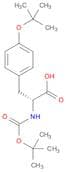
N-[(1,1-Dimethylethoxy)carbonyl]-O-(1,1-dimethylethyl)-D-tyrosine
CAS:N-[(1,1-Dimethylethoxy)carbonyl]-O-(1,1-dimethylethyl)-D-tyrosinePurity:99%Molecular weight:337.41g/molN-[(1,1-Dimethylethoxy)carbonyl]-O-(1,1-dimethylethyl)-D-tyrosine
CAS:Purity:97%Molecular weight:337.4159851Boc-D-Tyr(tBu)-OH
CAS:Boc-D-Tyr(tBu)-OH is a natural product that is an amphipathic molecule with a cyclic structure. It has been shown to be able to inhibit the growth of bacteria, such as Staphylococcus aureus and Escherichia coli, by acting as an antibiotic. Boc-D-Tyr(tBu)-OH inhibits the synthesis of peptides by binding to the ribosome and blocking peptide elongation. This molecule also inhibits peptide synthesis by interacting with the aminoacyl site on the ribosome and preventing it from binding with amino acids. Boc-D-Tyr(tBu)-OH is synthesized in two stages: solid phase peptide synthesis and nucleophilic activation. The decapeptides are then purified and characterized based on their function.Formula:C18H27NO5Purity:Min. 95%Color and Shape:PowderMolecular weight:337.41 g/mol

![N-[(1,1-Dimethylethoxy)carbonyl]-O-(1,1-dimethylethyl)-D-tyrosine](/_next/image/?url=https%3A%2Fstatic.cymitquimica.com%2Fproducts%2F54%2Fthumb%2FOR95967.jpg&w=3840&q=75)

![N-[(1,1-Dimethylethoxy)carbonyl]-O-(1,1-dimethylethyl)-D-tyrosine](/_next/image/?url=https%3A%2Fstatic.cymitquimica.com%2Fproducts%2F10%2Fthumb%2FF636873.jpg&w=3840&q=75)