CAS 5081-37-8
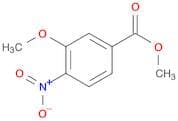
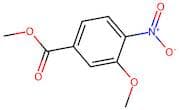
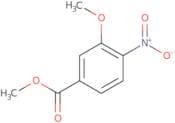
:Methyl 3-methoxy-4-nitrobenzoate
Description:
Methyl 3-methoxy-4-nitrobenzoate, with the CAS number 5081-37-8, is an organic compound belonging to the class of benzoates. It features a methoxy group (-OCH3) and a nitro group (-NO2) attached to a benzoate structure, which contributes to its chemical reactivity and properties. This compound is typically a pale yellow to light brown solid or liquid, depending on its purity and specific conditions. It is known for its aromatic characteristics, which can influence its solubility in organic solvents. Methyl 3-methoxy-4-nitrobenzoate is often utilized in organic synthesis, particularly in the preparation of various pharmaceuticals and agrochemicals, due to its functional groups that can undergo further chemical transformations. Additionally, it may exhibit biological activity, making it of interest in medicinal chemistry. Safety data should be consulted for handling and storage, as it may pose health risks if ingested or inhaled. Overall, this compound serves as a valuable intermediate in chemical research and industrial applications.
Formula:C9H9NO5
InChI:InChI=1/C9H9NO5/c1-14-8-5-6(9(11)15-2)3-4-7(8)10(12)13/h3-5H,1-2H3
SMILES:COc1cc(ccc1N(=O)=O)C(=O)OC
Synonyms:- 3-Methoxy-4-nitrobenzoic acid methyl ester
- Acid Methyl Ester
Sort by
Purity (%)
0
100
|
0
|
50
|
90
|
95
|
100
Found 4 products.
Methyl 3-methoxy-4-nitrobenzoate
CAS:Formula:C9H9NO5Purity:98%Color and Shape:SolidMolecular weight:211.1715Methyl 3-methoxy-4-nitrobenzoate
CAS:Methyl 3-methoxy-4-nitrobenzoatePurity:99%Molecular weight:211.17g/mol3-Methoxy-4-nitrobenzoic acid methyl ester
CAS:3-Methoxy-4-nitrobenzoic acid methyl ester is a dianellidin, a type of natural product. It is an ionizing acid that catalyzes the reaction between carboxylic acids and hydroxyl compounds. This compound is used to produce some drugs, such as methyldopate, which is an antiarrhythmic drug that slows heart rate. The catalytic rate of 3-methoxy-4-nitrobenzoic acid methyl ester can be increased by buffers and solvents (e.g., methanol). These compounds increase the concentration of the reactants in solution and reduce the activation energy required for the reaction to take place. Uncatalyzed reactions are slow because there are no molecules to act as intermediates in the process.
Formula:C9H9NO5Purity:95%NmrColor and Shape:PowderMolecular weight:211.17 g/mol