CAS 5089-22-5
:1,4-Bis(2-benzoxazolyl)naphthalene
Description:
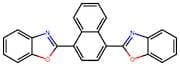
1,4-Bis(2-benzoxazolyl)naphthalene, with the CAS number 5089-22-5, is an organic compound characterized by its structure, which consists of a naphthalene core substituted with two benzoxazole groups at the 1 and 4 positions. This compound exhibits notable fluorescence properties, making it of interest in various applications, including as a fluorescent probe or in materials science. It typically appears as a solid at room temperature and is soluble in organic solvents. The presence of the benzoxazole moieties contributes to its photophysical characteristics, including absorption and emission spectra, which can be influenced by the solvent environment. Additionally, this compound may exhibit thermal stability and can undergo various chemical reactions typical of aromatic compounds. Its unique structure and properties make it a subject of research in fields such as organic electronics, photonics, and sensor technology. Safety data should be consulted for handling and usage, as with any chemical substance.
Formula:C24H14N2O2
InChI:InChI=1S/C24H14N2O2/c1-2-8-16-15(7-1)17(23-25-19-9-3-5-11-21(19)27-23)13-14-18(16)24-26-20-10-4-6-12-22(20)28-24/h1-14H
InChI key:InChIKey=WFYSPVCBIJCZPX-UHFFFAOYSA-N
SMILES:C=1(C2=C(C(=CC1)C3=NC=4C(O3)=CC=CC4)C=CC=C2)C5=NC=6C(O5)=CC=CC6
Synonyms:- 1,4-Bis(2-benzoxazoly)naphthalene
- 1,4-Bis(2-benzoxazolyl)naphthalene
- 1,4-Bis(Benziazolyl-2-Yl-)Naphth-Alene
- 1,4-Di(2-benzoxazolyl)naphthalene
- 2,2'-Naphthalene-1,4-Diylbis(1,3-Benzoxazole)
- 2,2′-(1,4-Naphthalenediyl)bis[benzoxazole]
- 2-[4-(1,3-Benzoxazol-2-yl)naphthalen-1-yl]-1,3-benzoxazole
- Benzoxazole, 2,2′-(1,4-naphthalenediyl)bis-
- Benzoxazole, 2,2′-(1,4-naphthylene)bis-
- Fba 367
- Fluorescent Brightener 367
- Fluorescent Whitening Agent KCB
- Hostalux Kcb
- KCB
- Optical Brightener KCB
- Optical Brightening Agent KCB
- Optical Brightner KCB
- FLUORESCENT BRIGHTENER-KCB
- See more synonyms
Sort by
Purity (%)
0
100
|
0
|
50
|
90
|
95
|
100
Found 5 products.
1,4-Bis(benzo[d]oxazol-2-yl)naphthalene
CAS:Formula:C24H14N2O2Purity:96%Color and Shape:SolidMolecular weight:362.38021,4-Bis(benzo[d]oxazol-2-yl)naphthalene
CAS:Purity:98.0%Color and Shape:Solid, Pale yellow to yellow green powderMolecular weight:362.388000488281251,4-Bis(2-benzoxazolyl)naphthalene
CAS:Formula:C24H14N2O2Purity:>98.0%(HPLC)(N)Color and Shape:Light yellow to Amber to Dark green powder to crystalMolecular weight:362.391,4-Bis(1,3-benzoxazol-2-yl)naphthalene
CAS:1,4-Bis(1,3-benzoxazol-2-yl)naphthaleneFormula:C24H14N2O2Purity:>98.0%Color and Shape: green solidMolecular weight:362.38g/mol1,4-Bis(benzoxazolyl-2-yl)naphthalene
CAS:1,4-Bis(benzoxazolyl-2-yl)naphthalene is a chemical substance that belongs to the group of biocides. It is used as a preservative in plastics and textiles, as well as an analytical reagent for organic compounds. The reaction monitoring technique was used to determine the concentration of 1,4-bis(benzoxazolyl-2-yl)naphthalene in a solution. This technique involves ultrasonically dispersing the sample and forming droplets before thermocycling it to break down the matrix. The calibration curve was then plotted on a graph based on the number of cycles required to produce a certain fluorescence intensity. Multiple reaction monitoring (MRM) is an analytical method that can be used to identify different substances in a mixture by examining their characteristic spectra at different wavelengths. MRM is often used in conjunction with chromatography methods, such as gas chromatography or liquid chromatography, becauseFormula:C24H14N2O2Purity:Min. 98 Area-%Color and Shape:PowderMolecular weight:362.4 g/mol
![1,4-Bis(benzo[d]oxazol-2-yl)naphthalene](/_next/image/?url=https%3A%2Fstatic.cymitquimica.com%2Fproducts%2FIN%2Fthumb%2FDA003DMM.jpg&w=3840&q=75)

![1,4-Bis(benzo[d]oxazol-2-yl)naphthalene](/_next/image/?url=https%3A%2Fstatic.cymitquimica.com%2Fproducts%2F10%2Fthumb%2FF235754.jpg&w=3840&q=75)