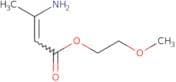
CAS 50899-10-0
:2-Butenoic acid, 3-amino-, 2-methoxyethyl ester
Description:
2-Butenoic acid, 3-amino-, 2-methoxyethyl ester, with the CAS number 50899-10-0, is an organic compound characterized by its ester functional group and the presence of both an amino group and a butenoic acid moiety. This compound typically exhibits properties associated with esters, such as being a liquid at room temperature and having a pleasant, fruity odor. The presence of the amino group suggests potential for hydrogen bonding, which can influence its solubility in polar solvents. The methoxyethyl group contributes to its overall hydrophobic character, affecting its reactivity and interaction with other chemical species. This compound may be used in various applications, including as an intermediate in organic synthesis or in the development of pharmaceuticals. Its reactivity can be attributed to the unsaturation in the butenoic acid part, making it susceptible to addition reactions. Overall, 2-butenoic acid, 3-amino-, 2-methoxyethyl ester is a versatile compound with potential utility in chemical synthesis and research.
Formula:C7H13NO3
InChI:InChI=1S/C7H13NO3/c1-6(8)5-7(9)11-4-3-10-2/h5H,3-4,8H2,1-2H3
InChI key:InChIKey=XJOLYWNYMOPRKQ-UHFFFAOYSA-N
SMILES:O(C(C=C(C)N)=O)CCOC
Synonyms:- 2-Butenoic Acid, 3-Amino-, 2-Methoxyethyl Ester
- 2-Methoxyethyl 3-aminocrotonate
- 2-Methoxyethyl β-aminocrotonate
- 2-Methoxyethyl 3-aminobut-2-enoate
- 2-Methoxyethyl 3-aminobut-2-enoate
Sort by
Purity (%)
0
100
|
0
|
50
|
90
|
95
|
100
Found 1 products.
2-Methoxyethyl-3-aminocrotonate
CAS:2-Methoxyethyl-3-aminocrotonate is an impurity of a drug product. It is an analytical standard that is used to quantify the metabolite in pharmaceutical preparations. 2-Methoxyethyl-3-aminocrotonate is a natural metabolite, which can be found in human urine. This compound has been shown to be a potent inhibitor of both bacterial and mammalian cell topoisomerase II and IV, but not mammalian cell topoisomerase I. It also inhibits protein synthesis by binding to the ribosomal 50S subunit. In addition, it has been shown to inhibit the growth of certain bacteria such as clostridium perfringens and Mycobacterium tuberculosis.
Formula:C7H13NO3Purity:Min. 95%Molecular weight:159.18 g/mol